



Mastering positional trading risk management goes beyond setting a single stop-loss on an isolated trade.
They are held for months. Each one reacts to different news at a different time.
Positional trading risk management at this level is not about any single stop-loss.
This post is about what happens once you are holding several positions at once.
Why Positional Traders Face Higher Portfolio Risk?
Positional trades sit open for weeks or months. That is a long window for several positions to overlap.
They react to unrelated news and can quietly build up risk you are not tracking anywhere.
Choosing the best timeframe for positional trading decides how long that overlap window stays open.
Our positional trading strategy guide already covers the per-trade stop-loss maths in full.
This post stays focused on the portfolio picture above that.
Swing vs Positional: Where Overlap Risk Quietly Builds?
A swing trader cycles through positions faster, so overlap risk resets more often.
A positional trader carries it for far longer, which makes tracking it properly worth the extra effort.
If you are still new to the style itself, our guide on what positional trading is covers the basics.
Our comparison of positional trading vs day trading also shows how a longer holding period changes your risk.
Why Tracking Total Risk Prevents Big Losses?
Portfolio heat is the total risk across every open position added together.
If you hold four positional trades, each risking 1.5 percent of your capital, your total heat is 6 percent.
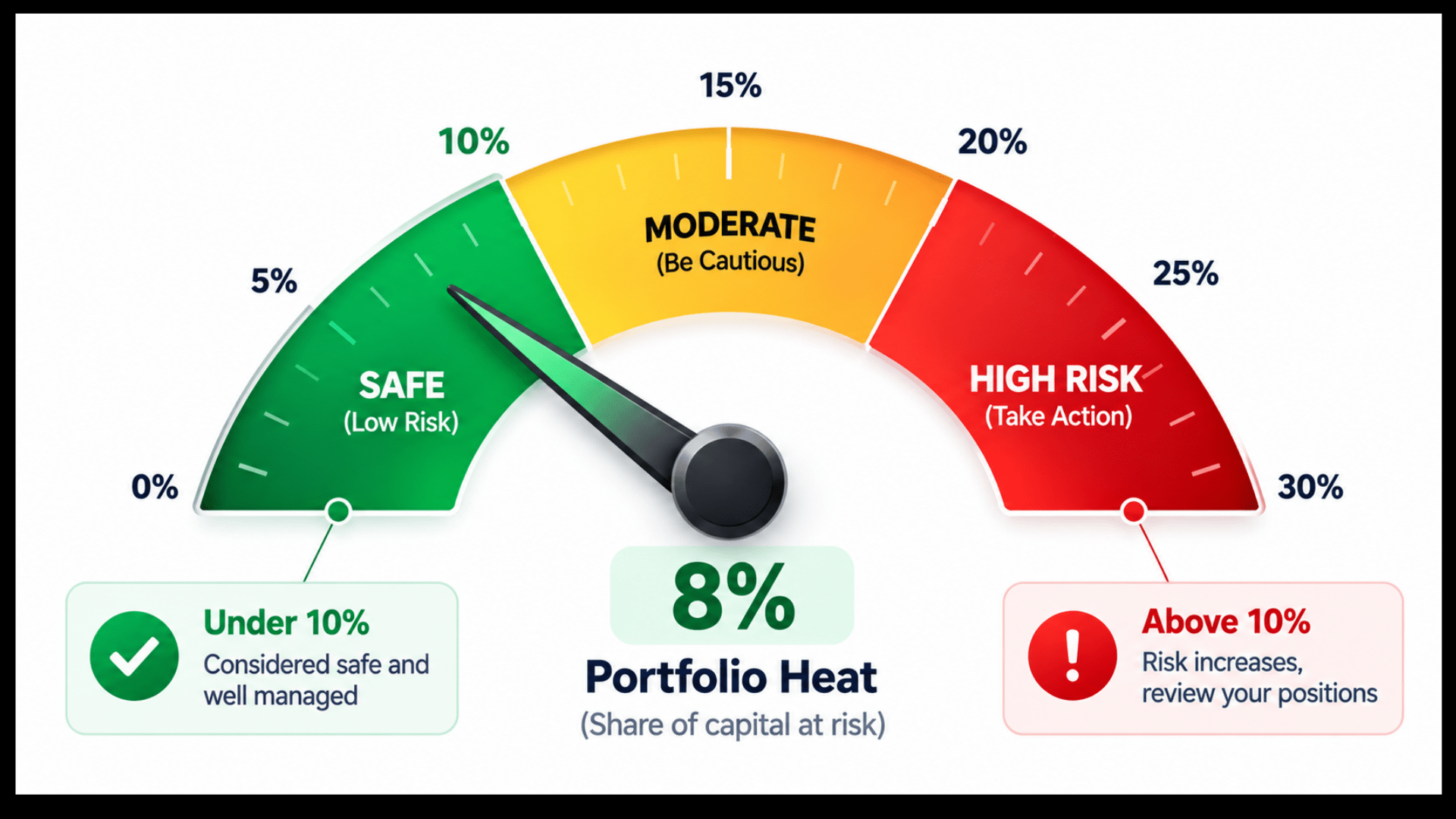
That number tells you the worst realistic outcome if every position hit its stop the same week.
It is unlikely, but not impossible. Keeping total heat under roughly 6 to 10 percent is a sensible ceiling for most individual traders.
How Stock Correlation Ruins Diversification: Positional Trading Risk Management
Holding five different positional trades feels diversified. If four of them sit in the banking sector, they are likely to move together.
This is especially true during a sector-wide event or a broad market fall.
That is not five independent risks. It is closer to one concentrated risk spread across four tickers.
Check your open positions by sector, not just by count, before assuming you are properly spread out.
Why Stock Selection Alone Won’t Save You?
This is one more reason a proper screen matters before you even open a position.
Our guide on how to select stocks for positional trading already checks sector strength.
Solid fundamental analysis for positional trading helps you pick quality names too.
But neither automatically prevents you from accumulating too much exposure to one sector across several trades.
How Derivatives and Options Amplify Positional Trading Risk
Significantly. Futures and options work differently from plain equity delivery.
Choosing them for a positional view adds leverage, and with it, a layer of risk delivery based trading does not carry.
That added risk shows up in three ways: speed of loss, time decay and tax.
Each one is covered below:
1. Leverage Moves Faster Than Your Stop Loss
A leveraged position can move against you faster and further than the same trade in plain equity.
Position size needs to shrink to compensate.
Your maximum acceptable loss on any one leveraged trade should be smaller in rupee terms than on an equivalent delivery trade.
2. Time Decay and Tax: The Hidden Extra Layers
Time decay adds a second layer if you are using options specifically.
A directionally correct view can still lose value if the move takes longer than expected to play out.
That is worth weighing before choosing options over futures or equity delivery for a positional view.
The tax treatment shifts too once you move to F&O for a positional trade.
Our guide on positional trading tax in India explains how that changes what you actually keep.
Managing Overnight Gaps: Essential Positional Trading Risk Rules
Every open positional trade carries exposure to news that happens while the market is shut.
The more positions you hold at once, the more separate overnight events you are exposed to in any given week.
This is not a reason to avoid positional trading. It is a reason to size positions conservatively.
No single overnight gap, even an unusually large one, should threaten more capital than you have already decided you can afford to lose.
A Worked Example: When Two Trades Become One Loss
These figures are illustrative and are not a recommendation.
You hold four positional trades on a ₹5,00,000 account, each risking 1.5 percent.
That makes a total portfolio heat of 6 percent, or ₹30,000. Two of the four are in the IT sector.
A weak set of IT sector results triggers a sharp sector-wide fall. Both IT positions hit their stops the same week.
That is a combined loss close to ₹15,000, half your total heat, from what was really one correlated event rather than two independent ones.
Tracking sector concentration ahead of time would have flagged this exposure before the trades were even opened, not after the loss.
How Often Should You Actually Review Your Portfolio Risk?
Weekly is enough for most positional traders.
Check your open positions by sector, add up your current total heat, and confirm no single overnight event could breach your comfort level.
This pairs naturally with the broader discipline habits in our positional trading rules guide.
Reviewing risk without reviewing process tends to miss half the picture.
Want Help Managing Risk Across a Full Positional Portfolio?
Reading about portfolio heat is one thing. Tracking it in real time, across live positions, takes structure and practice.
Our positional trading classes build this into every live session, on real Indian stocks.
Conclusion
Managing risk on one trade is straightforward. Managing it across several open positions, held for months, takes a different kind of attention.
Different sectors and sometimes different instruments add layers that a single stop cannot see. That is the real core of positional trading risk management.
Track your total portfolio heat every week, watch for hidden sector correlation, and size leveraged F&O positions smaller than delivery trades.
Keep overnight exposure in check by sizing conservatively.
That combination protects you from the risk a single stop-loss rule was never designed to catch, and keeps one bad week from undoing months of disciplined trading.
Frequently Asked Questions
Before investing capital, invest your time in learning Stock Market.
Fill in the basic details below and a callback will be arranged for more information: