



Stop loss placement and position sizing get covered plenty elsewhere. This post is about the part that gets skipped.
The habits and discipline that decide whether you actually follow your own plan.
Positional trading rules here means process, not maths.
Positional Trading Entry Rules
Most trading mistakes happen before the buy order, not after it.
These first four rules cover what to settle before any money goes in, starting with how you pick the setup itself.
Rule 1: Fix Your Positional Trading Setup Before You See the Stock
Never let a stock’s story talk you into a trade.
Decide your entry criteria in advance, then only act when a real stock actually meets them.
If you want the entry, stop and target maths instead; our positional trading strategy guide covers that in full.
This sounds obvious. It is broken constantly, usually when a stock has already moved.
A trader then chases it in out of fear of missing the rest of the move.
If you are still new to this trading style overall, our guide on what positional trading is a good starting point.
Rule 2: Follow the Confirmed Trend in Positional Trading, Not the Predicted One
Enter based on where the trend already is, not where you think it is about to go.
A confirmed setup beats a clever guess almost every time.
Trying to catch the exact bottom before a trend confirms is a losing habit, even for experienced traders.
Waiting costs a small piece of the move but improves your odds meaningfully.
Indicators can help you spot that confirmation, and positional trading with MACD is one common way traders check a trend has actually turned.
Rule 3: Set a Review Date Before Entering a Positional Trade
Decide, at entry, when you will formally review the trade if it has neither hit your target nor your stop.
Six to eight weeks is a reasonable default for a positional hold.
Without this rule, a stagnant trade quietly ties up your capital for months.
With it, you are forced to ask whether the original reason still holds.
Rule 4: Never Trade Against the Broader Market Trend
A stock can look technically perfect while the wider market is falling.
Broad weakness tends to drag good setups down too, so glance at the Nifty trend before committing to anything new.
This one habit, checked in seconds, prevents a surprising number of avoidable losses.
Positional Trading Rules for Open Trades: Where Discipline Quietly Slips
Once a trade is live, the pressure changes.
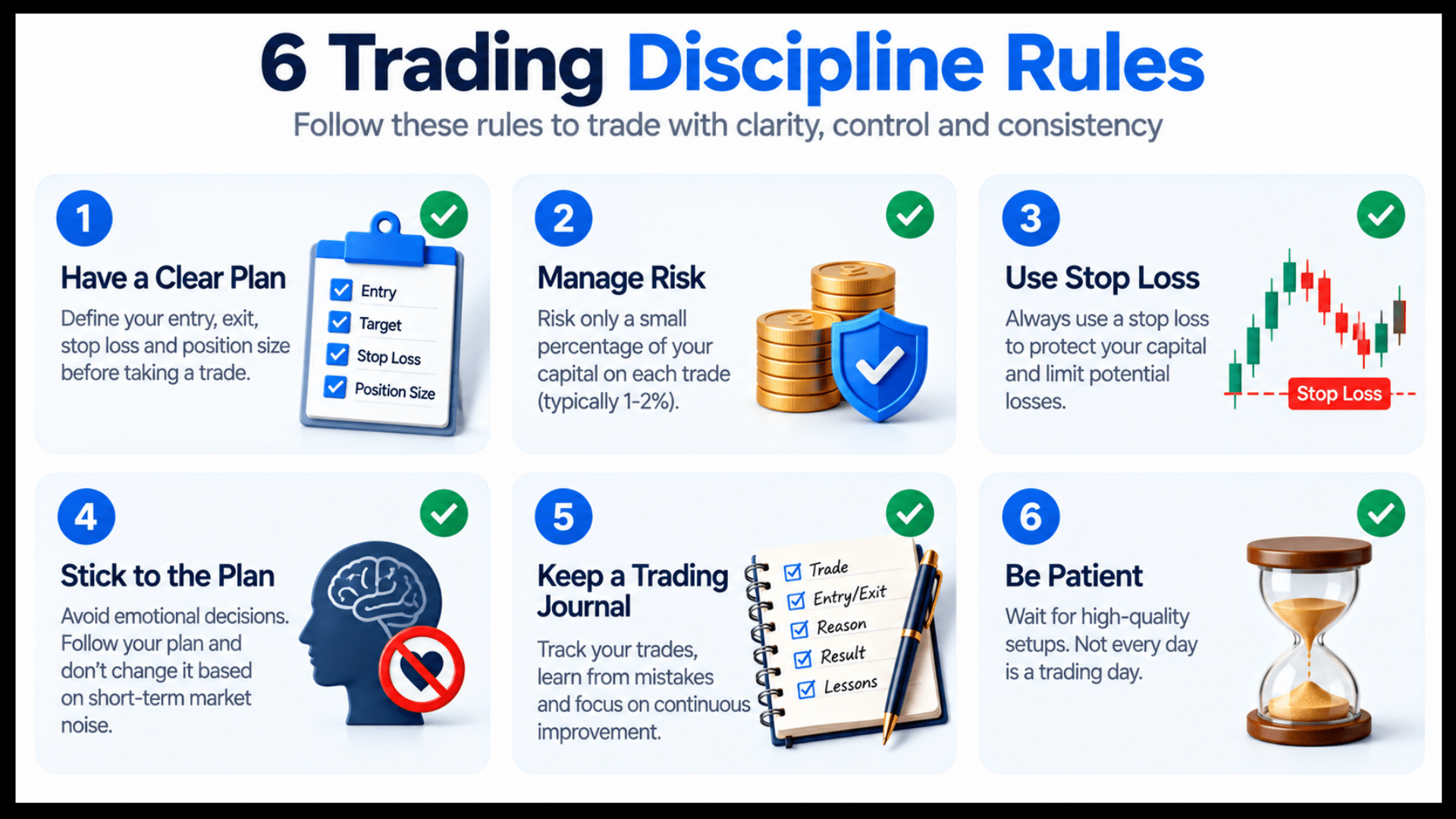
The next four rules keep greed, fear and drift from rewriting your plan, beginning with the habit most traders skip: the journal.
Rule 1: Keep a Positional Trading Journal, and Actually Read It Back
Log every trade. The setup used, the entry and exit, and the reasoning at the time. Winners and losers both.
The value is not in the logging itself. It is in reviewing it monthly, honestly.
That review tends to reveal patterns you would never notice trade by trade, like consistently exiting winners too early.
Some traders now use positional trading with AI tools to spot these patterns faster, but the honest read back still matters most.
Rule 2: Fix Your Exit Strategy Before Entering a Positional Trade
Whether you plan to trail a stop, exit on a moving average close, or take a fixed target, decide which applies before you enter.
That choice should be made for this specific trade, not trades in general.
Switching your exit logic mid trade, usually out of greed on a runner or fear on a dip, is one of the more expensive habits a positional trader can develop.
Rule 3: Respect the Earnings Calendar on Every Positional Holding
Know the results date for any stock you are holding, the moment you enter.
Decide in advance whether you will hold the full position through it, trim it, or exit before it.
Our guide on fundamental analysis for positional trading goes deeper into what to actually check once results are out.
Rule 4: Set a Strict Limit on Your Open Positional Trades
Three to six open positional trades is a realistic ceiling for most individuals.
Beyond that, you are not genuinely managing each one, you are just watching a list grow.
This also protects you from a single sector event hitting too much of your capital at once.
That risk rises if several positions came from the same how to select stocks for positional trading screen.
Why Do Losing Trades Happen Even When You Follow Positional Trading Rules?
Yes, and the final rule explains why.
It is less about the chart and more about how you read your own results, which is where many traders quietly lose their discipline.
Rule: Accept That Losses Are Part of a Positional Trading Process
No rule set here removes losing trades. Even a genuinely good setup loses close to half the time.
A loss that respects your planned stop is the system working, not a failure.
The real warning sign is a loss bigger than planned.
That happens because a rule got broken somewhere along the way, not because the market did something unusual.
This discipline matters even more if you also trade faster styles elsewhere, since switching pace without switching rules, something we cover in our comparison of positional trading vs day trading, is a common way habits from one style leak into the other.
The Essential Positional Trading Pre-Trade Checklist
Before every entry, run through the same short list.
It takes under a minute and catches most avoidable mistakes.
- Does this setup meet my predefined entry criteria, specifically?
- Have I checked the broader market trend supports this direction?
- Do I know the stock’s next results date, and my plan for it?
- Is my stop loss decided and ready to place?
- Do I already know my exit plan for this trade?
If any answer is no, the trade waits.
Ready to put these positional trading rules into live practice?
Rules are easy to agree with and hard to follow the first time real money is on the line.
Our positional trading classes in India build this discipline into every live session.
Conclusion
Positional trading rules are not about clever maths or perfect entries. They are about doing the same simple things every single time, even when skipping them feels harmless.
Decide your setup early, respect the trend, check the market and plan your exit before money goes in.
Then keep a journal, read it back honestly and accept planned losses as part of the system.
Do this consistently, and every trade stops being a fresh gamble and becomes one more step in a repeatable process you can trust and improve.
Frequently Asked Questions
Before investing capital, invest your time in learning Stock Market.
Fill in the basic details below and a callback will be arranged for more information: