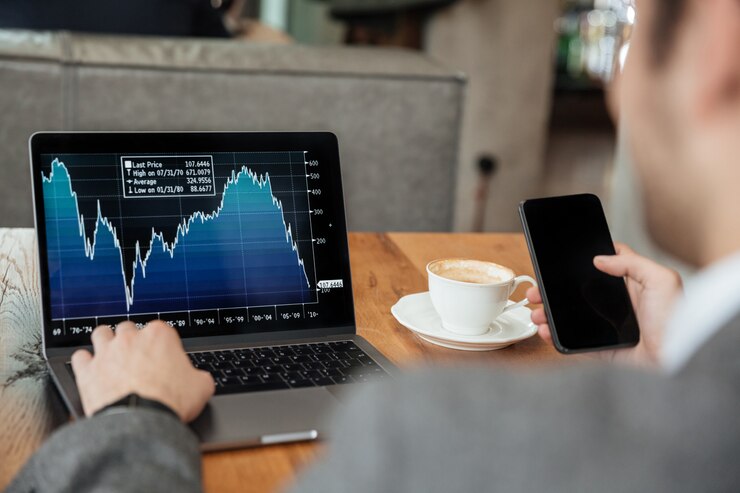


If you have ever looked at a price chart and felt completely lost, you are not alone. Raw price data is messy, unpredictable, and full of noise that can push even experienced traders into bad decisions.
That is exactly why the advantages of moving average make it one of the most widely used tools in trading.
A moving average smooths out all that chaos and gives you a clean, simple line that shows where the price is actually heading.
It does not predict the future, but it helps you make smarter decisions in the present.
Whether you are a beginner just starting out or an experienced trader refining your strategy, moving averages are a tool you simply cannot ignore.
In this blog, let us break it all down in a simple and straightforward way.
What Is A Moving Average?
Before we talk about the advantages, let’s understand the concept. The average price of an item over a given number of periods is called a moving average.
It updates continuously as price changes. The basic moving average calculation involves adding up the closing prices of a stock over a specific number of days and then dividing that total by the same number of days.
There are two main types:
- Simple Moving Average (SMA)
- Exponential Moving Average (EMA)
The core debate of SMA vs EMA comes down to how much weight you give to recent data, as these help traders notice reversals, recognize trends, and manage trades more effectively.
Although the reasoning is simple, the impact on your trading can be significant.
Moving Average Method Example
It’s one thing to understand the theory. It becomes clearer when you see it on a chart.
The moving average approach plots the result as a line on the chart after averaging a certain number of past price data points.
The average “moves” ahead with price each day as the oldest data point is removed and the newest is added.
Example Scenario:
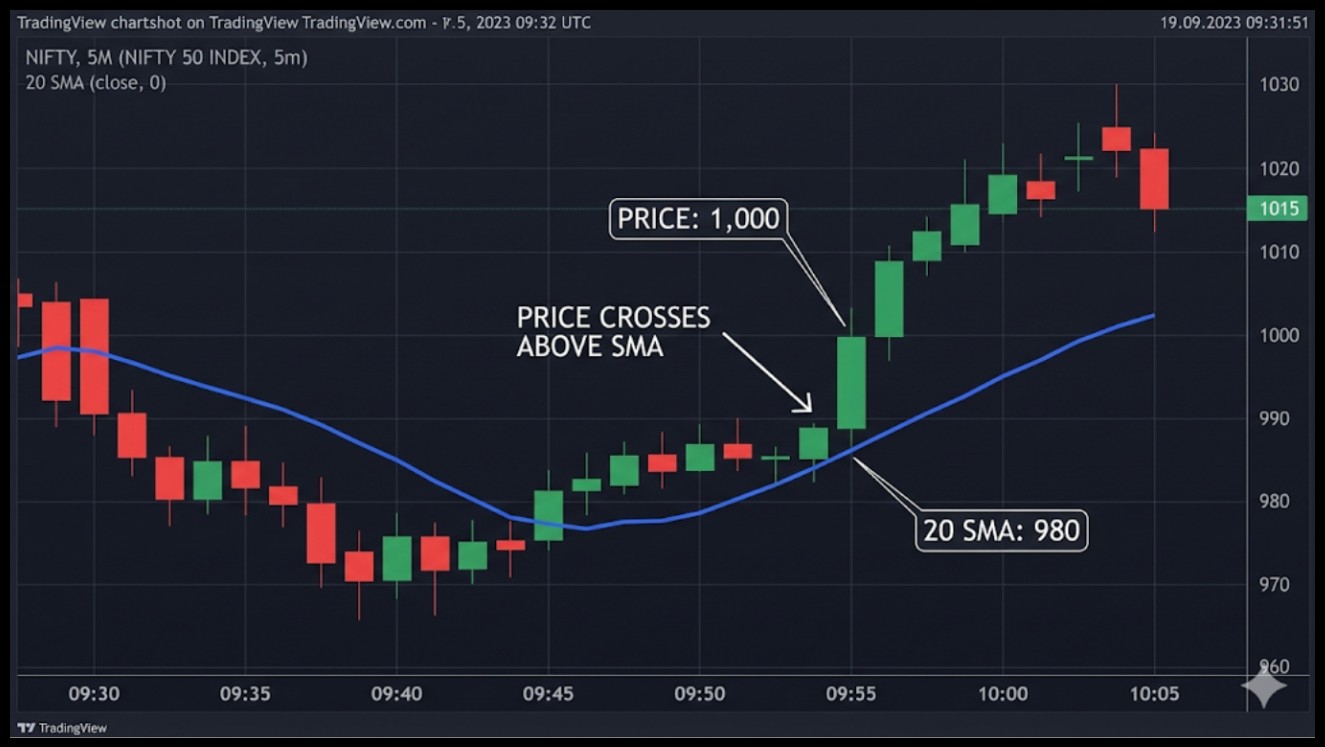
- Stock price: 1,000
- 20-day SMA: 980
- Price crosses above the SMA
Trade Plan:
- Entry: 1,005 after confirmation
- Stop-loss: 970 (below SMA)
- Target: 1,060 (risk-reward 1:2)
This example shows how traders use moving averages for entries and risk control. It’s more important to respond intelligently than to forecast.
Advantages Of Moving Average In Trading
What makes moving averages powerful is their simplicity. It turns noisy price data into something readable.
It helps traders stay focused on the overall trend rather than reacting to small price moves.
Key advantages include:
- Smooths price fluctuations and reduces noise
- Helps identify trend direction clearly
- Acts as dynamic support and resistance
- Works across all timeframes and markets
For instance, it signals a bullish trend if the Nifty is trading above its 50-day moving average.
During pullbacks to this level, traders frequently search for buying opportunities.
For instance:
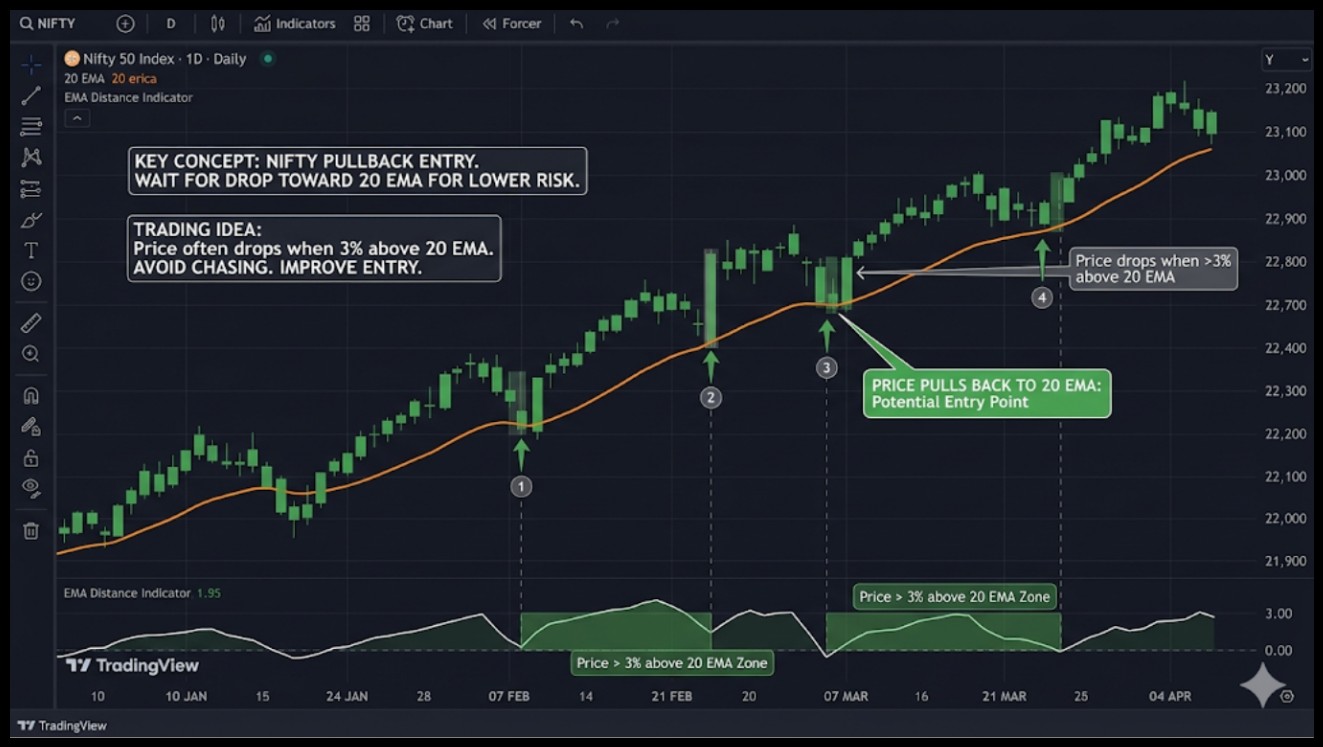
The Nifty frequently has a little drop down toward the average when it is trading 3% above its 20 EMA.
This idea explains why pullback entries are so effective in markets that are trending.
Traders lower risk and improve entry quality by waiting for the price to recover closer to the value rather than chasing it.
Advantages Of Simple Moving Average
The main strength of SMA is its clarity and stability. It’s steady and less sensitive to sudden spikes because it treats all prices equally.
Why Traders Use SMA:
- Easy to calculate and understand
- Provides smoother trend lines
- Reduces false signals in volatile markets
SMA Formula: If a stock’s closing prices over 5 days are ₹100, ₹102, ₹98, ₹104, ₹106 — the 5-day SMA is (100+102+98+104+106) ÷ 5 = ₹102
Example:
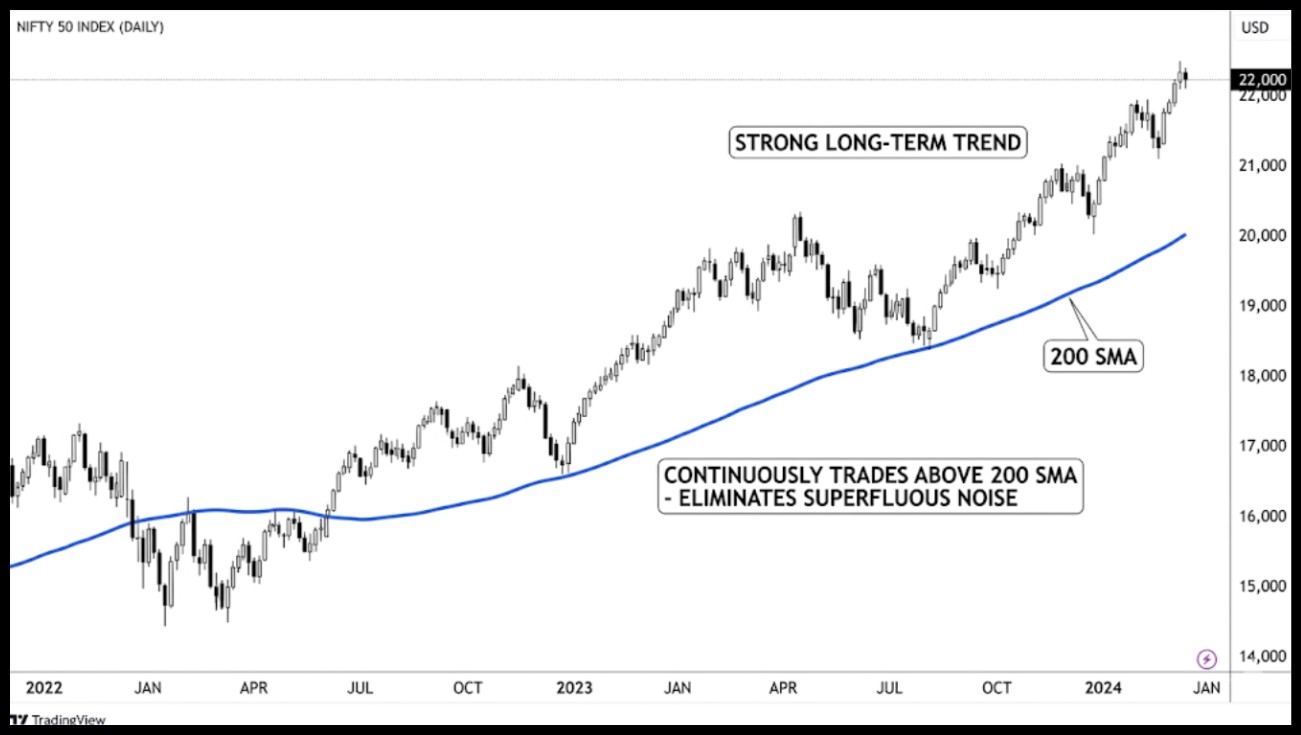
A stock has a strong long-term trend if it continuously trades above its 200 SMA. This is a standard that investors frequently use when making portfolio selections.
Although SMA occasionally feels sluggish, this slowness frequently eliminates unnecessary noise.
Advantages Of Exponential Moving Average
Now let’s shift focus. The responsiveness of the exponential moving average is one of its benefits. It reacts more quickly by giving current prices more weight.
Key Benefits:
- Faster signals compared to SMA
- Better for short-term trading
- Captures early trend changes
Example:
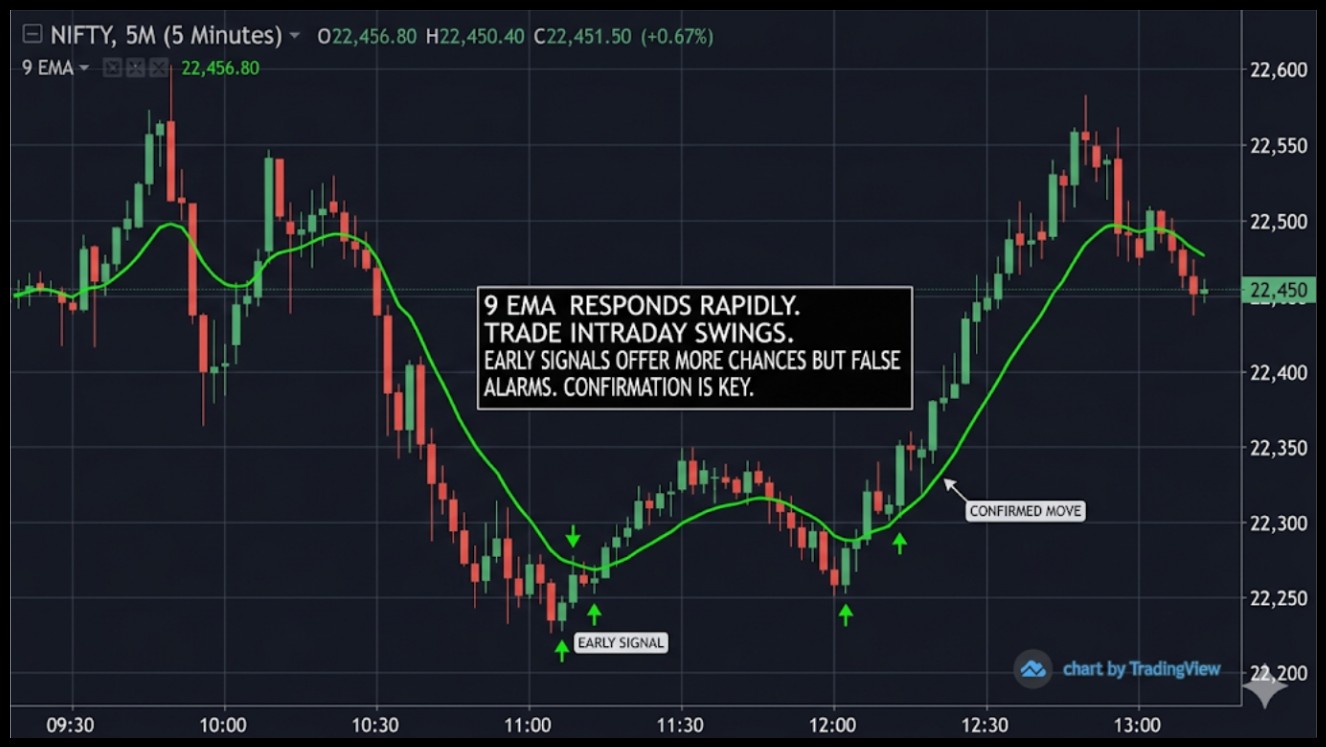
Deciding which exponential moving average to use depends on your trading style; for instance, a 9 EMA responds rapidly to changes in price momentum on a 5-minute chart. During intraday swings, traders use it to initiate trades early.
This comes with a trade-off. Faster signals mean more opportunities, but also more false signals. Confirmation is important because of this.
Benefits Of Moving Average Forecasting
Moving averages are useful for more than simply trading. They are also used for trend forecasting. They make it simpler to spot recurring trends over time by smoothing out erratic data patterns.
Benefits Of Moving Average Forecasting:
- Identifies long-term direction
- Filters short-term volatility
- Helps in demand and price forecasting
Moving averages help traders estimate where the price might find support next. For example, if the 50 EMA is increasing at a rate of 2% per week, traders may forecast where the price will be in the upcoming days and plan their entry accordingly.
The 20 EMA shows short-term momentum. The 50 EMA reflects the medium trend. The 200 EMA defines the long-term direction. Together, they act like a forecast map.
The forecast confidence is at its maximum when all three agree.
Disadvantages Of Moving Average
No tool is perfect. You can use it more effectively if you understand both sides.
The merits and demerits of moving average method become clear when you look at both advantages and limitations together.
Many traders often ask is moving average a good indicator despite its lagging nature, and the answer lies in its ability to simplify complex data, even if it performs poorly in certain market conditions.
Some disadvantages of moving average are:
- Lagging indicator: Signals may cause entry delays since they appear after the price has begun to move.
- Performs badly in sideways markets: Frequently produces misleading signals when there is no discernible trend in the market.
- Might produce false signals during turbulent times: Unexpected price increases may cause deceptive crossings.
Despite being straightforward, moving averages are frequently abused. Why? Because traders often rely on them without considering the market context.
How Traders Actually Use Moving Averages?
A single moving average is rarely used by traders in actual markets. To improve precision, they blend them.
This approach gives a clearer view of both short-term momentum and broader trend direction while also aiding in the filtering of false signals.
Common Approaches:
- Crossover strategies like the 9 EMA strategy and the 21 EMA strategy
- Using 50 and 200 SMA for long-term trend
- Combining with the RSI or MACD EMA strategy for confirmation
- Works seamlessly with other indicators like RSI, MACD, and Bollinger Bands
One highly effective setup is the EMA and Bollinger Band strategy, where traders look for the price to touch the outer bands while the EMA confirms the strength of the trend.
This combination helps in identifying overextended markets and high-probability reversal points.
Practical Scenario:
- Price above 50 EMA
- Pullback to EMA
- Bullish candle forms
This becomes a high-probability entry. A moving average is a guide, not a guarantee. Although it keeps you in touch with the trend, discipline and confirmation are still necessary for the ultimate choice.
Conclusion
The advantages of moving averages go beyond ease of use. In volatile markets, they offer structure, cut down on noise, and direct decision-making.
The secret is to combine them with appropriate risk management and market context, whether you choose EMA for speed or SMA for stability.
They won’t make you perfect, but they can help you stay consistent.
And what really counts in trading is consistency.
Take the next step with our stock market classes, where moving averages are taught through real charts and practical sessions.
FAQs
Q1: Is EMA Better than SMA?
Ans: While SMA is smoother and more appropriate for long-term trend analysis, EMA is quicker and better for short-term trading.
Q2: Is It Possible to Use Moving Averages on Their Own?
Ans: Although they may be used independently, their accuracy is increased, and false signals are decreased when combined with indicators such as RSI or volume.
Q3: Are Moving Averages Effective in Every Market Situation?
Ans: In markets that are trending, they perform well. Moving averages should be utilised carefully since they might produce false signals in sideways or choppy situations.
Before investing capital, invest your time in learning Stock Market.
Fill in the basic details below and a callback will be arranged for more information: