


Traders have chased the dream of a perfect strategy for centuries, and somehow, two simple lines on a chart keep stealing the spotlight.
But the real question that keeps traders up at night is: Is EMA crossover profitable?
The honest answer is that it depends far more on how you apply the strategy than on the strategy itself. This is because the same two lines can make one trader rich and another frustrated.
Let’s dig into what really makes EMA crossovers work in actual trading.
What is EMA Crossover?
First, let’s understand what EMA crossover actually means and what its success rate is.
An Exponential Moving Average (EMA) responds faster to price changes than a simple moving average because of how the moving average calculation is structured; it assigns higher mathematical weight to the most recent data points.
If the short-term EMA jumps above the long-term one, you get a bullish signal.
If it falls below, that’s bearish.
The short EMA catches quick movement, while the long EMA smooths out the noise and points at the broader trend. That’s why traders, beginners and pros alike, keep EMA crossovers handy.
Is Ema Crossover Profitable or Not?
EMA crossovers can be profitable, but not on their own. When used without filters or confirmation tools, historical data shows false signal rates as high as 57% to 76%.
This means that the strategy fails more often than it succeeds in raw form.
However, when paired with volume confirmation, RSI filters, ADX readings above 25, and higher timeframe trend alignment, the win rate improves significantly.
The real profitability comes from consistent execution in trending markets, not from the crossover signal alone.
Let us have a look at the EMA crossover performance to understand how profitable it can be.
Moving Average Crossover Strategy Success Rate
The fact is that the moving average crossover strategy’s success rate varies according to the asset and the period you are choosing; however, in reality, the real numbers say it all:
- Short-term crossovers: 55–65% accuracy
- Medium-term crossovers: 60–70% accuracy
- Long-term crossovers: 65–76% accuracy
Why does it get better as you stretch the timeframe?
It’s simple: longer trends throw off fewer false signals, so you’re not whipsawed in and out of trades.
Still, it’s not about being right every time; what matters is staying consistent. That’s where the real profit comes from.
Most Profitable Moving Average Crossover
Not all EMA combinations are equal. If you go with the 5/13 EMA crossover, you get a fast signal, great for quick trades, but it’s easy to get tripped up in choppy markets.
This is often a preferred EMA crossover for intraday traders who need to capture small momentum shifts within a single session.
- 5/8/13 EMA Crossover Strategy: Uses three EMAs for layered confirmation; popular among intraday traders for capturing strong momentum with reduced false signals.
- 5/13 EMA Crossover: Works well for short-term trades; reacts quickly but may have false signals in choppy markets.
- 12/26 EMA Crossover: Popular for swing trading; balances speed and reliability.
- 20 and 50 EMA crossover: Ideal for long-term trends; slower but more reliable for positional trades.
When looking at an EMA crossover for swing trading, the 12/26 EMA is a popular choice because it balances speed and reliability over several days.
There’s no magic formula. The right crossing of the EMA will be according to the style and the extent of risk you want to assume.
Be patient and not only focus on the indicators, but also on what is happening in the market. That is what usually makes the difference between those who win and those who continue losing.
How Profitability Depends on Market Conditions?
When prices move steadily, you can catch big swings. But in markets that zigzag with no clear direction, expect false alarms and small losses.
For example, consider Bank Nifty futures:
- 10-day EMA crosses above 50-day EMA
- Price continues upward by 300 points
- If a trader sticks to the plan and rides the trend, using a solid stop-loss, they can catch most of the move.
The strategy becomes genuinely profitable when it’s paired with sharp market awareness. Follow the rules, stay flexible as trends shift, and you’ll see your long-term results get a lot better.
What Makes EMA Crossover Profitable?
Raw EMA crossovers can generate false signals if used in isolation. Applying specific filters turns them into a high-probability strategy.
This is where traders often apply an EMA and RSI strategy to filter weak signals and improve trade accuracy.
Here’s what studies and backtesting suggest:
- Higher Timeframe Trend Alignment: Only take action when there is a crossover in the daily or weekly trend direction.
- Volume Confirmation: This needs at least 1.5 times the 20-day average at the crossover candle.
- RSI Filter: It is recommended to only take buy signals when RSI exceeds 50 and only sell signals when RSI falls below 50.
- ADX Filter: Trade when ADX is above 25 (i.e., the market is in an upward trend).
MA crossovers work, but only in strong, clear trends. Run them with these filters to keep your edge.
Is EMA Crossover Profitable for the Long Term?
Yes, but with caveats. EMA crossovers can generate sustained profits in long-term trending markets, but they require:
- Larger stop-loss distances to accommodate volatility
- Patience to let trades play out
- Complementary analysis, like trendlines or support/resistance
For example, if Nifty is in a 6-month uptrend:
- 50 EMA above a 200 EMA indicates a bullish macro trend
- Every 20/50 EMA bullish crossover provides potential entries
- Traders ride multiple long trades over weeks for compounded gains
Therefore, if trend filters and risk management are added, EMA crossovers might be beneficial in the long run.
Over time, prospective signals become actual gains when the rules are consistently followed and impulsive transactions are avoided.
Note: Just because a combination worked in a trending market doesn’t mean it’ll hold up when the market’s moving sideways or getting volatile.
Markets fluctuate, and what used to work well yesterday may crumble easily tomorrow when times change.
Historical backtests will not help you cultivate a false sense of security. It is dangerous to use set EMA settings without monitoring them.
Do not define your strategy and walk away, but keep your eye on your EMA parameters. Change approach with market changes.
That’s how you stay profitable.
How to Trade EMA Crossover?
Understanding profitability isn’t enough; execution matters. Here’s how traders implement EMA crossovers:
Step 1: Choose Your EMAs
- Short-term EMA for sensitivity
- Long-term EMA for trend confirmation
Picking the right EMAs sets the foundation for accurate signals.
Step 2: Identify the Crossover
- Short EMA crossing above long EMA = potential buy
- Short EMA crossing below long EMA = potential sell
Recognizing crossovers early helps you capture momentum efficiently.
Step 3: Confirm With Price Action
- Check trend direction
- Look for pullbacks to enter at better prices
Confirmation with price action reduces false signals and improves entry timing.
Step 4: Set Risk Parameters
- Stop-loss below recent swing low (for long trades)
- Take-profit at realistic risk-reward ratios (1:2 or 1:3)
Proper risk management ensures you protect capital and maximize potential gains. This approach reduces emotional trading and filters out weak signals.
Example of a Profitable EMA Crossover Trade
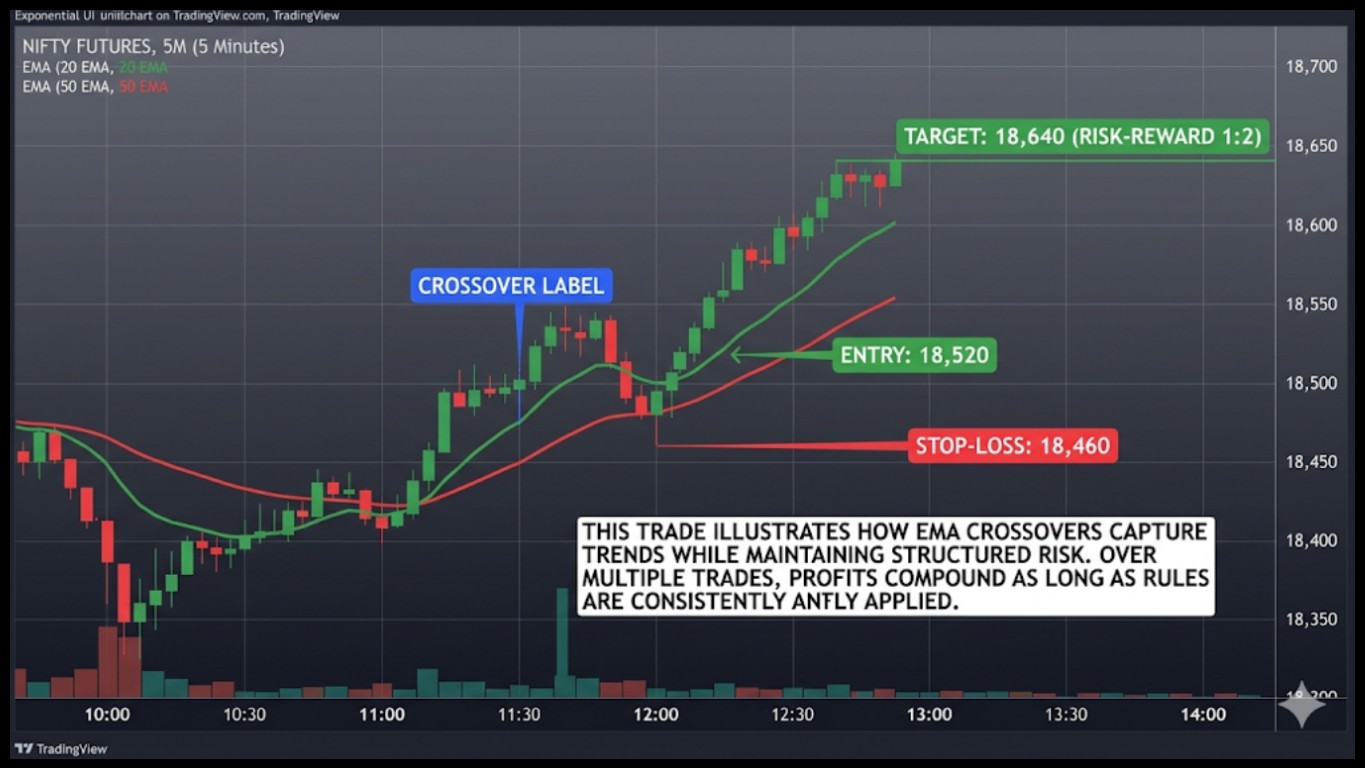
Let’s put numbers to it for clarity:
- Asset: Nifty Futures
- Short EMA: 20
- Long EMA: 50
- Crossover: 20 EMA crosses above 50 EMA at 18,500
- Entry: 18,520 (after minor pullback)
- Stop-loss: 18,460
- Target: 18,640 (risk-reward 1:2)
This trade shows how the trades using EMA crossover help capture trends with structured risk.
Profits multiply over several transactions provided that a set of rules is always followed.
Factors Influencing EMA Crossover Profitability
Technical precision is not enough; external pressure has a greater influence on success. But the point is, what matters? Remaining consistent in your plan.
EMA crossover profits can be broken or made for several reasons:
- Market Volatility: A high volatility may initiate false crossovers.
- TimeInterval Choice: Short-term crossovers respond quickly but are noisy, whereas long-term crossovers are slow yet more robust.
- Discipline: The pursuit of money-making and disregard for stop-losses minimizes profitability.
- Confirmation Tools: Using trendlines, volume, or RSI alongside EMAs improves accuracy.
Consistency and discipline win out over chasing after every little signal. The traders who stay steady and stick to their rules, the ones who actually follow their plans, are usually the ones who end up ahead.
Common Mistakes Traders Make
Small errors, when repeated, can quickly turn a winning strategy into a losing one.
Even simple systems like EMA crossovers fail when traders repeat certain mistakes:
- Entering trades without trend confirmation
- Ignoring risk management
- Overtrading during choppy markets
- Changing EMA settings mid-trade
When you keep your approach steady, small wins start piling up, turning into something substantial over time.
Conclusion
EMA crossovers can be profitable but only when used the right way. They work best in trending markets, where they help capture momentum rather than predict it.
Whether you’re day trading, swing trading, or investing for the long term, EMA crossovers can be a powerful tool when paired with solid risk management, proper trend confirmation, and patience.
The concept itself is simple, but turning signals into consistent profits depends entirely on disciplined execution.
Take your understanding further with our technical analysis classes, where EMA strategies are explained using real charts and practical market setups.
FAQs
Q1: Can EMA crossover work in sideways markets?
Ans: EMA crossovers perform poorly in choppy or sideways markets, as false signals are common. Trend filters help avoid losses.
Q2: What is the best EMA combination for long-term trades?
Ans: 50/200 EMA is widely used for positional trades, providing fewer false signals and better trend capture.
Q3: How does risk management impact profitability?
Ans: Crossovers look promising, but that’s not enough. Without smart stop-losses and honest risk-reward ratios, even the best trades can unravel quickly.
Before investing capital, invest your time in learning Stock Market.
Fill in the basic details below and a callback will be arranged for more information: