



When growing your wealth, choosing between positional trading vs mutual fund investment really comes down to one core question: how much control do you actually want over your money?
One puts you firmly in the driver’s seat, while the other hands the wheel to someone else. This guide breaks down what changes depending on which path you choose.
Positional Trading vs Mutual Fund Investment: Who Is Really Driving Your Returns?
In a mutual fund, a professional manager and their team decide which stocks to buy and sell. That happens inside the fund’s stated strategy.
You are trusting their process, not making any individual stock calls yourself.
In positional trading, every decision is yours. Which stock, when to enter, where the stop sits, when to exit.
Nobody stands between you and the outcome.
If you are new to the trading side of this comparison, our guide on what positional trading is covers the basics first.
Positional Trading vs Mutual Fund Investment: Key Differences Explained
Before we go deeper, here is the comparison in one place.
Read on afterward for the reasoning behind each row.
| Factor | Positional trading | Mutual fund investment |
|---|---|---|
| Who decides | You, on every trade | A professional fund manager |
| Time needed | A few hours a week | Very little, checked occasionally |
| Diversification | Limited, a handful of positions | Built in, dozens of holdings |
| Costs | Brokerage per trade | Annual expense ratio |
| Control | Full control over entries and exits | None over individual stock decisions |
| Skill required | Chart reading and discipline | Choosing a suitable fund |
Active Market Trades vs Professional Funds: The Real-World Breakdown
A table shows the differences, but not how they feel in practice.
The next few sections break down the five areas that matter most: time, diversification, cost, control, and tax.
Start with the one most people underestimate: your time.
Time Commitment in Positional Trading vs Mutual Fund Investment
A mutual fund, especially through a SIP, can run almost hands-off.
Set it up, and the ongoing work is small, mostly checking in occasionally to confirm the fund still fits your goals.
Positional trading needs a real weekly habit. Reviewing charts, checking open positions, and rebuilding a watchlist.
Our guide on how to select stocks for positional trading covers that process.
Diversification in Positional Trading vs Mutual Fund Investment Explained
Significantly, yes, diversification works differently. Even a single equity mutual fund typically holds twenty or more stocks, spreading risk across sectors automatically.
A positional trading account, running a sensible three to six open positions at a time, is far less diversified by design.
That concentration is not automatically bad. You are not trying to replicate a fund’s spread.
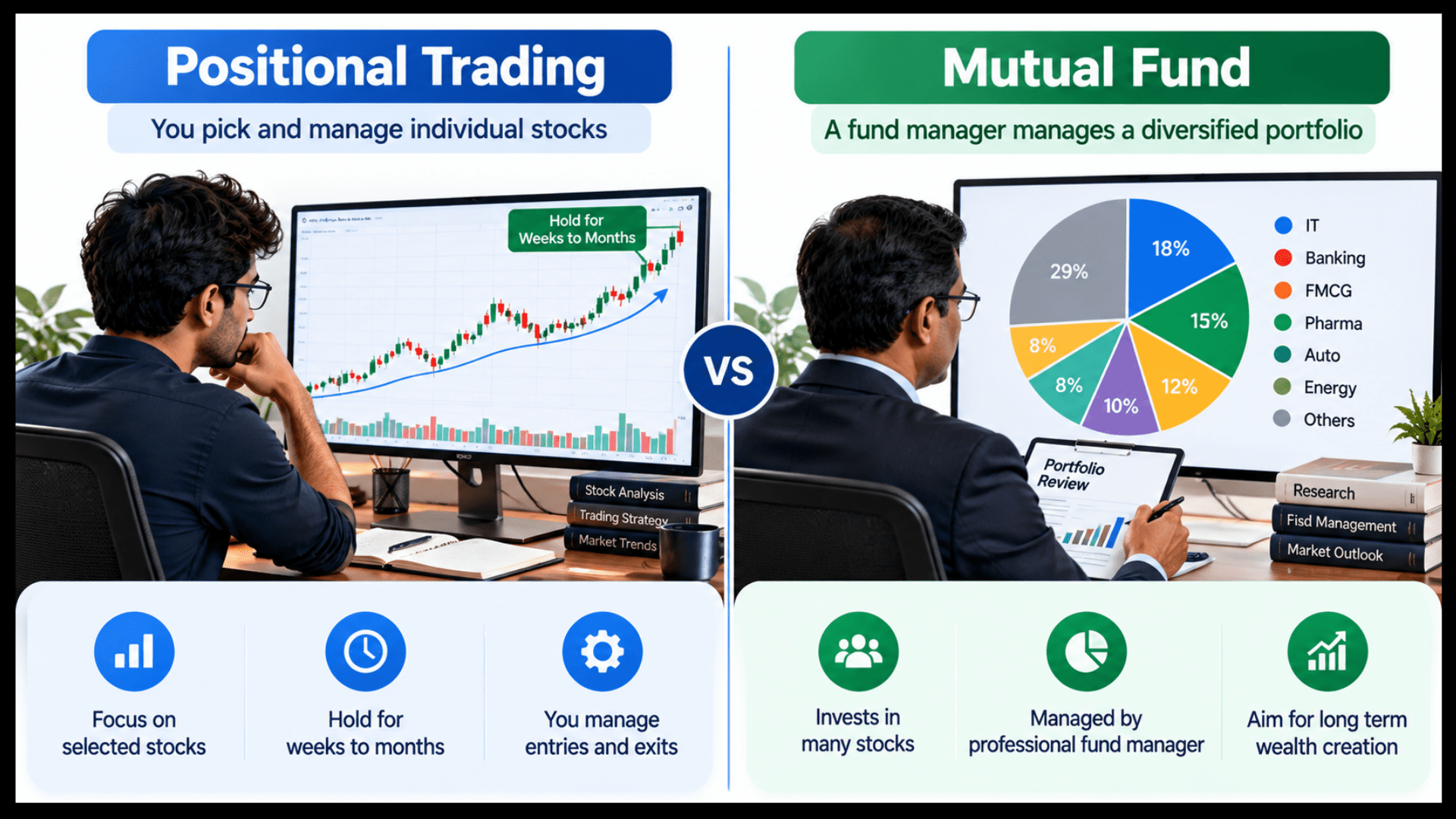
But it does mean each position carries more individual weight, so picking that handful well matters.
Some traders now use positional trading with AI tools to shortlist those few candidates faster.
Costs of Positional Trading vs Mutual Funds: Which One Bites Harder?
Mutual funds charge an expense ratio, a recurring annual fee taken from the fund’s assets, regardless of how the fund performs that year.
Positional trading costs are transactional, brokerage and charges on each trade you place.
A trader running only a handful of trades a month may pay less overall than a higher expense ratio fund.
This depends entirely on your own trading frequency.
Control in Positional Trading vs Mutual Funds: Driver’s Seat or Back Seat?
Positional trading, by a wide margin. You choose the entry, the stop loss, and the exit on every single trade.
That works best with a clear plan, like the one in our positional trading strategy guide.
Mutual fund investors have no say over individual stock decisions inside the fund.
Your outcome depends entirely on the manager’s process and the fund’s stated approach.
Tax on Positional Trading vs Mutual Funds: Same Rules or Different?
They can differ, depending on how each is structured.
Equity mutual funds generally follow the same capital gains framework as direct equity, short-term or long-term based on holding period.
Positional trading has its own details worth knowing, especially if you trade delivery equity versus futures and options.
Our guide on positional trading tax in India breaks down both routes in full.
Positional Trading vs Mutual Fund Investment: Can You Run Both?
Rarely, and this is the most useful takeaway from this whole comparison.
Many people run a mutual fund portfolio quietly in the background, mostly through SIPs.
Alongside it, they keep a separate, smaller pool of capital for active positional trades.
Because this active capital is exposed to market fluctuations over several sessions, allocating it effectively requires strict positional trading risk management from the start.
The mutual fund money is not meant to be touched often. The positional money is meant to be worked.
If your comparison is really about holding period rather than who manages the decision, our post on positional trading vs long term investing covers that angle instead.
Active Trading vs Mutual Funds: A Simple Way to Decide
Ask yourself one honest question. Do you want to make the calls yourself, or hand that responsibility to someone else and check in occasionally?
If you enjoy following a chart and reacting to it, positional trading rewards that instinct directly.
Methods like positional trading with MACD give that instinct a clear, rule-based structure.
If you would rather trust a process built by someone else, mutual funds suit you better.
Want to Learn the Active Side of Positional Trading vs Mutual Funds?
If your long term investing already runs quietly through mutual funds, you can actively manage a separate portion of your capital.
Our best positional trading classes teach that from the ground up, live.
Conclusion
Positional trading vs mutual fund investment is not really a battle with one winner. Both aim to grow your money, just in very different ways.
Positional trading asks for your time, judgement, and discipline every single week. Mutual funds ask for very little once you have picked a fund you trust.
Most people are not purely one type, and many happily run both side by side.
Figure out which pull is stronger in you, active control or managed calm, and the decision becomes far easier than it first looked.
Frequently Asked Question
Before investing capital, invest your time in learning Stock Market.
Fill in the basic details below and a callback will be arranged for more information: