



If you have just started looking into swing trading, you have probably noticed something. Most ‘beginner’ guides throw ten indicators at you and call it a strategy. If you want a reliable swing trading strategy for beginners, you are in the right place.
That is not what this is.
This is a swing trading strategy for beginners built around one clean setup you can actually follow without a screen full of confusing lines. If your goal is to learn Swing Trading the right way, start here.
You will learn how to pick a stock, when to enter, where to place your stop loss, and when to book profit, along with the swing trading rules that keep you from blowing up your account in your first month.
What the Day-to-Day Reality of Swing Trading Looks Like?
Swing trading means holding a stock for a few days to a few weeks to capture one “swing” in price, not the whole trend and not just a few minutes.
You are not glued to the screen like an intraday trader.
Understanding what is swing trading helps clarify why this approach requires far less screen time than active day trading.
You are also not parking money for years like a long-term investor.
You check your charts once a day, usually after market close, and you act on what you see. Getting comfortable with Swing Trading time frames early on makes this rhythm much easier to stick to.
A simple example. Suppose Tata Motors is trading at ₹780 and has just broken out of a two-week sideways range with rising volume.
You buy at ₹782, place your stop loss at ₹755, and set a target of ₹830. Over the next nine trading days, the stock moves to ₹825. You exit.
That entire trade, start to finish, took less than two weeks and needed maybe ten minutes of your attention each evening.
The Beginner Swing Trading Setup, Step by Step
Step 1: Pick liquid, trending stocks
Stick to stocks with decent daily volume and a clear trend on the daily chart.
Incorporating a disciplined swing trading ema strategy into your stock selection criteria ensures you only focus on assets with confirmed directional momentum.
Illiquid small caps might move fast, but you will struggle to exit cleanly when things go wrong.
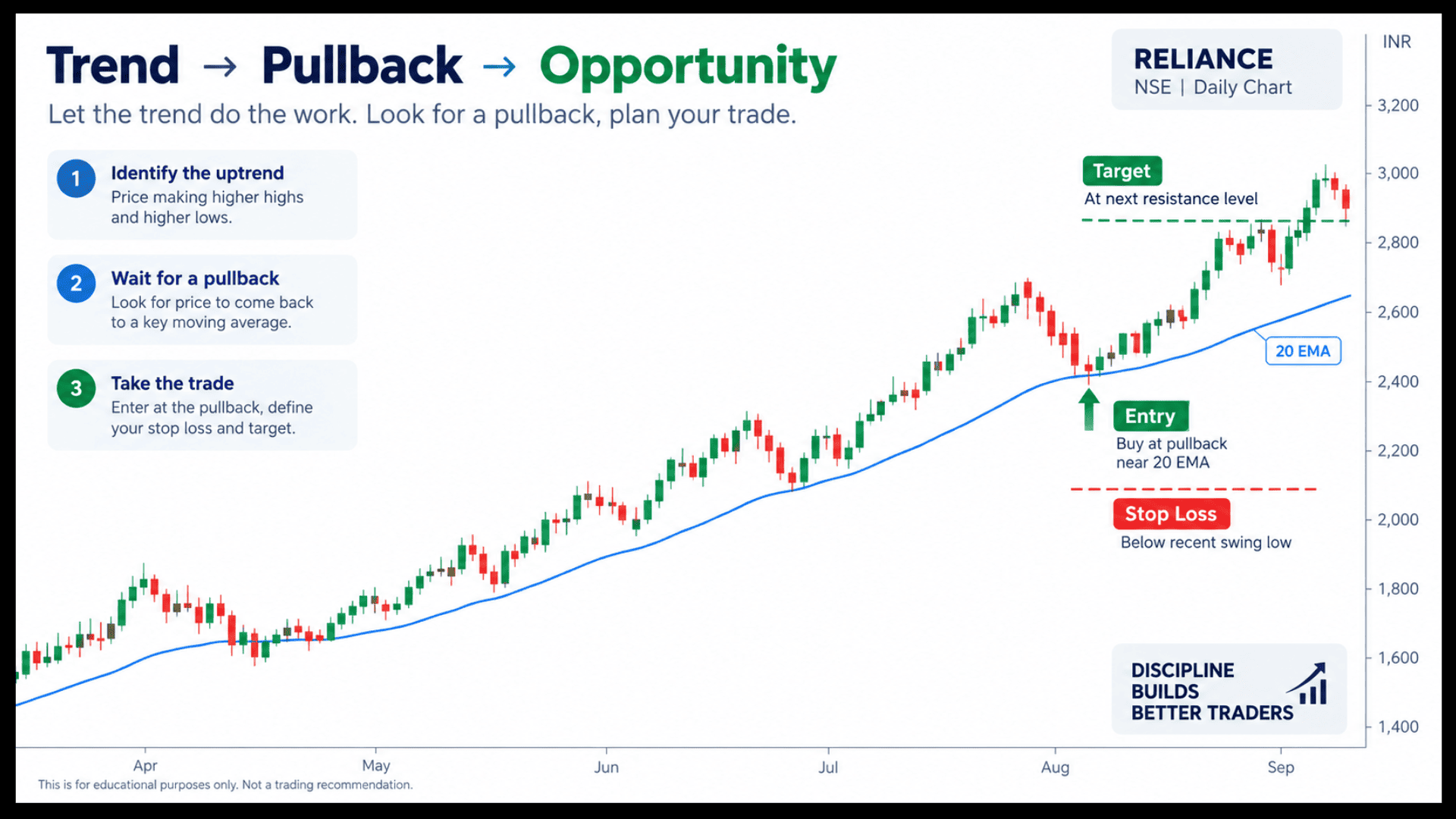
Step 2: Wait for a pullback or a breakout
Two entry patterns work well for beginners:
- A pullback entry: the stock is in an uptrend, dips toward a moving average or a prior support level, then shows signs of turning back up.
- A breakout entry: the stock has been consolidating in a range, then breaks above resistance on higher-than-average volume.
Step 3: Define your stop loss before you enter, not after
This is where most beginners fail. They enter first and figure out the exit later, usually after the stock has already moved against them.
Decide your stop loss the moment you plan the trade.
When measuring potential volatility expansion and channel width during this planning phase, applying concepts related to swing trading with Bollinger Bands can help you set realistic price targets.
A common approach is placing it just below the most recent swing low, or a fixed percentage (say 3 to 5 percent) below your entry.
Step 4: Set a realistic target
A 1:2 or 1:3 risk-to-reward ratio is a reasonable starting point. If you are risking ₹25 per share, look for a setup that can realistically give you ₹50 to ₹75.
Step 5: Exit on schedule, not on emotion
Decide in advance whether you will exit at a fixed target, trail your stop as the stock moves up, or exit after a set number of days regardless.
Pick one and stick to it for your first several trades before you start improvising.
Core Risk Management Rules Every Beginner Swing Trader Needs?
Risk management is not a separate topic from strategy. It is the strategy.
Here are the swing trading rules that matter most when you are starting out.
- Risk only 1 to 2 percent of your capital per trade. If your account is ₹1,00,000, that is ₹1,000 to ₹2,000 at risk on any single position, not the full trade value.
- Never average a losing position. Adding more shares to a trade that has moved against you is how small losses become account-ending ones.
- Cap your open positions. Three to five swing trades running at once is plenty for a beginner. More than that and you cannot track them properly.
- Always use a stop loss order, not a mental one. Mental stop losses get ignored the moment the stock is actually falling.
- Size positions by risk, not by conviction. How much you like a setup should not change how much of your capital you put behind it.
Important Swing Trading Patterns Worth Familiarizing Yourself With
You do not need to memorise fifty chart patterns to swing trade well. A handful cover most real opportunities:
- Trend continuation pullbacks, where price dips within an established uptrend before resuming.
- When trading these momentum retracements, many technical traders look for a swing trading strategy using MACD to signal the exact moment the pullback has concluded and buyers are stepping back in.
- Range breakouts where a stock breaks out of weeks of sideways movement.
- Similarly, incorporating a swing trading strategy using rsi helps traders identify overbought or oversold conditions during these corrective phases.
- Candlestick reversal patterns at support, such as a bullish engulfing candle or a hammer forming right at a level you were already watching.
Chart patterns like cup and handle also show up often in swing trades.
Traders often combine traditional chart formations with swing trading with fibonacci retracements to confirm potential reversal levels more accurately.
If you want to go deeper on that specific setup, we have a full breakdown in our cup and handle swing trading strategy guide.
Adding a structured cup and handle swing trading strategy to your routine can significantly improve how you identify accumulation phases.
A Simple Framework for Swing Trading Analysis
Before you take any trade, run through the same four questions every time:
- What is the overall trend on the daily chart?
- Answering this core question effectively begins by mastering swing trading with technical analysis to read directional momentum.
- Where is the nearest support and resistance?
- What is my entry trigger, specifically?
- Where exactly is my stop loss and target?
If you cannot answer all four clearly, it is not a trade yet. It is a guess.
Top Mistakes That Derail New Swing Traders
Overtrading is the biggest one. A genuinely good setup does not show up every single day. Forcing trades on mediocre setups just to stay “active” adds risk without adding any real edge.
Second is ignoring the broader market.
Adopting a reliable best swing trading strategy in bear market conditions requires recognizing that downward momentum can easily overwhelm otherwise promising stock charts.
A strong individual chart can still fail if Nifty or Bank Nifty is falling sharply on the same day.
Third is moving stop losses further away once a trade starts losing, hoping it will turn around. That is not a strategy. That is hope, and hope is not a swing trading rule anyone should be trading on.
How Much Daily Time This Strategy Actually Demands
One thing that surprises most beginners once they start: this is not a full-time job.
A realistic evening routine looks like scanning your watchlist for fifteen to twenty minutes after market close, checking any open positions against your predefined exit rules, and placing orders for the next session if a setup has triggered. That is genuinely it.
Compare that to intraday trading, where you are watching a screen continuously for hours, reacting to every tick. Swing trading trades that constant attention for patience, which is exactly why it suits people with a day job, college, or any other commitment that keeps them away from the market during trading hours.
Another Worked Example: The Breakout Setup
The pullback example earlier is one entry type. Here is how a breakout entry looks in practice, since beginners should be comfortable recognising both.
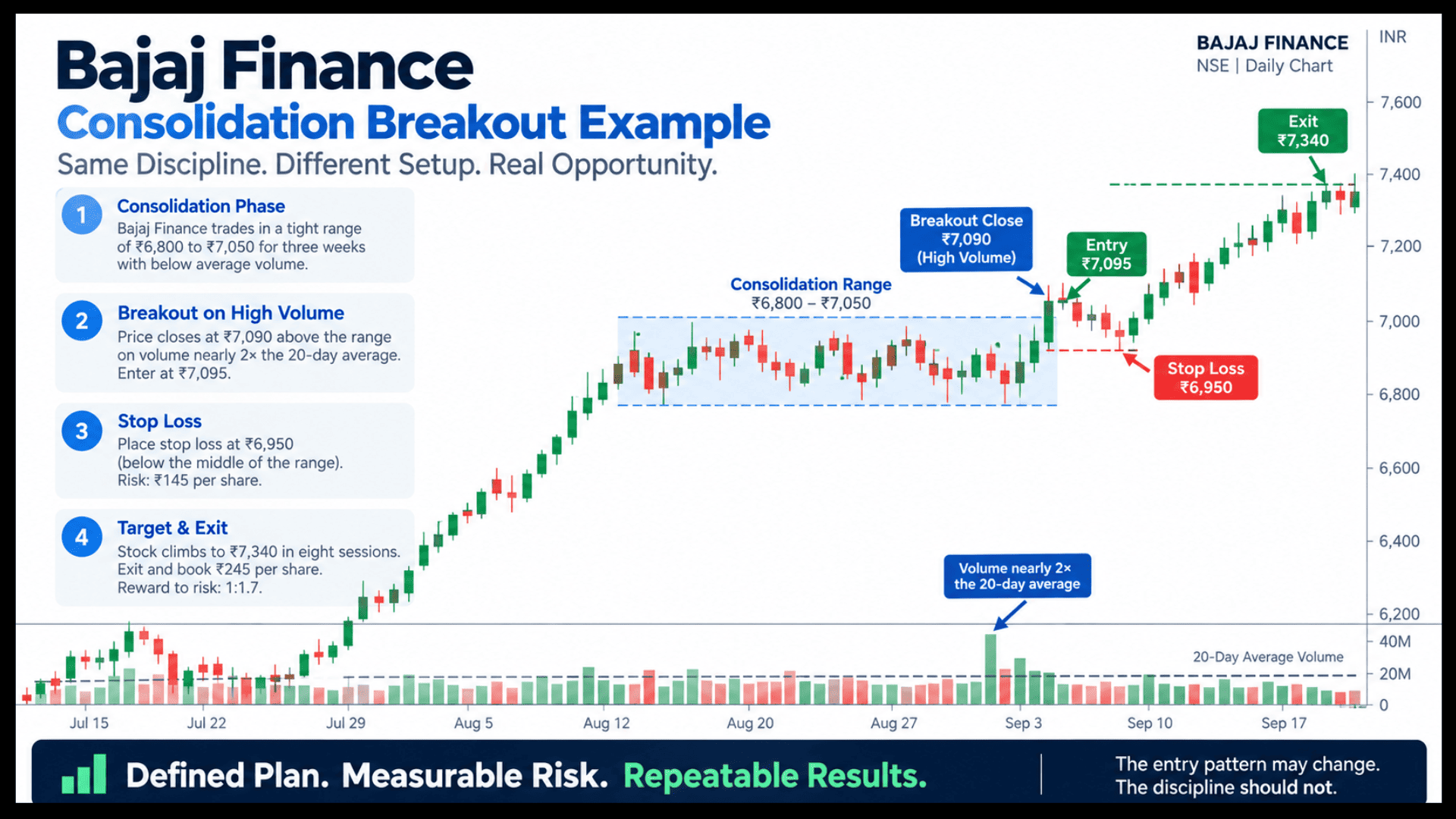
Suppose Bajaj Finance has been consolidating in a tight ₹6,800 to ₹7,050 range for three weeks, going nowhere in particular. Volume during this period stays below average, a sign the stock is genuinely resting rather than building toward a move.
Price finally closes at ₹7,090, above the top of that range, on volume nearly double the 20-day average. You enter at ₹7,095.
Your stop loss sits at ₹6,950, below the middle of the prior range, giving you a defined risk of ₹145 per share. Over the next eight sessions the stock climbs to ₹7,340, where you exit, booking ₹245 per share against your ₹145 risk, a 1:1.7 outcome.
Notice what stayed identical between this example and the pullback example earlier: a defined stop before entry, a realistic target, and an exit rule decided in advance. The entry pattern changed. The discipline around it did not, and that discipline is really the entire strategy.
How to Practise This Without Risking Real Money First
Before putting real capital behind this setup, paper trading it for two to three weeks is worth the patience.
Pick five to ten stocks on your watchlist, apply the exact same rules covered above, and track the outcomes as if the trades were real.
This does two things. It shows you honestly whether you can follow your own rules under (simulated) pressure, and it builds pattern recognition for what a genuine pullback or breakout actually looks like before you have money on the line reacting to every wiggle in price.
Alongside paper trading, working through a solid swing trading book can help the setups in this guide click faster, since seeing the same rules explained a different way often makes them stick.
Ready to Trade with a Structured Plan Instead of Guesswork?
Reading about a strategy and executing it live under real market pressure are two different skills.
If you want to practise this swing trading approach with live daily guidance instead of figuring it out alone, our Swing Trading Classes walk you through real setups on Indian stocks, in real time.
Conclusion
Swing trading rewards discipline more than prediction. Pick liquid stocks, wait for a clean pullback or breakout, and decide your stop loss and target before you enter, not after.
Risk 1 to 2 percent per trade, avoid overtrading, and respect the broader market’s mood. The two worked examples above show the same core habits at play: a defined risk, a realistic reward, and an exit rule set in advance.
Paper trade this setup for a few weeks first. Once you can follow your own rules under pressure, you are ready to trade it live.
Frequently asked questions
Before investing capital, invest your time in learning Stock Market.
Fill in the basic details below and a callback will be arranged for more information: