

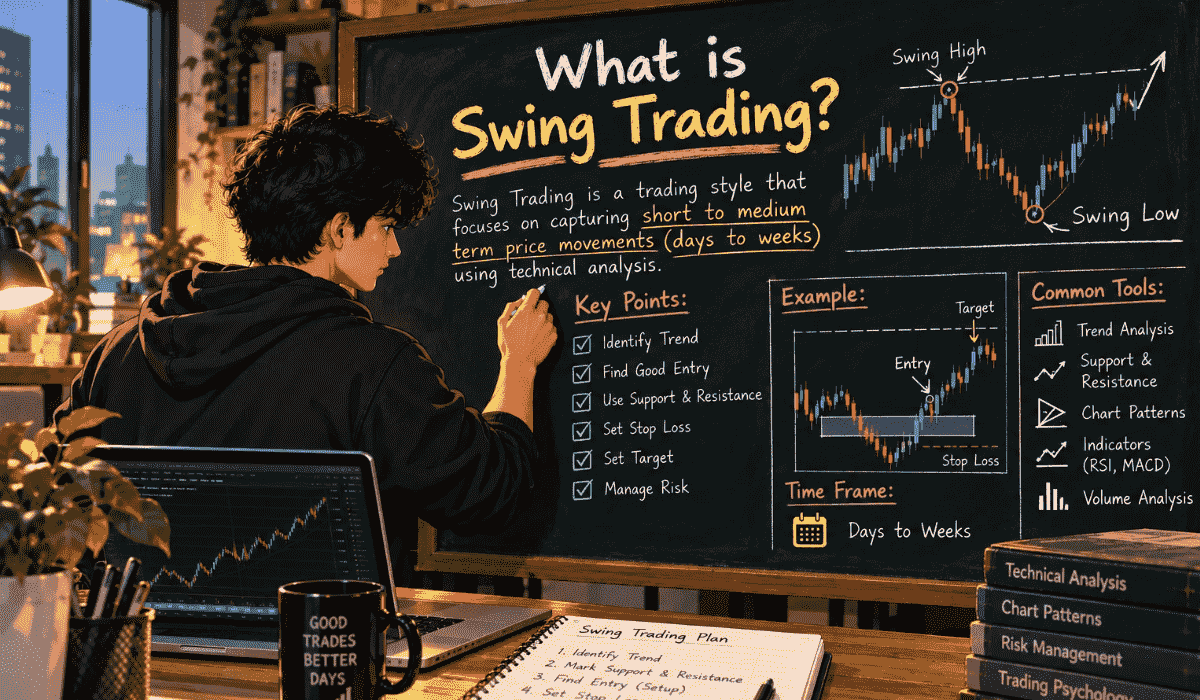
Swing trading is a style of stock market trading where you hold a position for a few days to a few weeks, aiming to profit from one meaningful price “swing”.
It is not about a single day’s movement or a multi-year investment. That is the swing trading meaning in its simplest form, and everything else in this guide builds on that one idea.
If you already have a rough sense of the concept and just want the actual strategy and rules, our swing trading strategy for beginners guide covers the execution side.
This post is about understanding how this style works, where it sits between other trading styles, and why so many people choose it.
Swing Trading Meaning: What Exactly Is a “Swing”?
Picture the stock market as constantly moving in waves. Within any longer trend, upward or downward, price rarely moves in a straight line.
It rallies, pauses, pulls back a little, then rallies again. Each of those individual moves, up or down, is a “swing.”
Technical analysts watch for classic swing trading patterns during these pauses to figure out whether the previous trend is likely to continue or reverse.
Swing trading means specifically trying to capture one of those swings, entering near the start of the move and exiting once it has largely played out.
It does not try to catch the entire multi-month or multi-year trend.
Indicators used in a trading strategy, such as RSI, for instance, help traders judge whether a swing is gaining strength or running out of steam.
Swing Trading Example: How One Infosys Trade Played Out in 12 Days
Suppose Infosys is trading at ₹1,500 and has just formed a clear bottom after a two-week pullback within a longer uptrend.
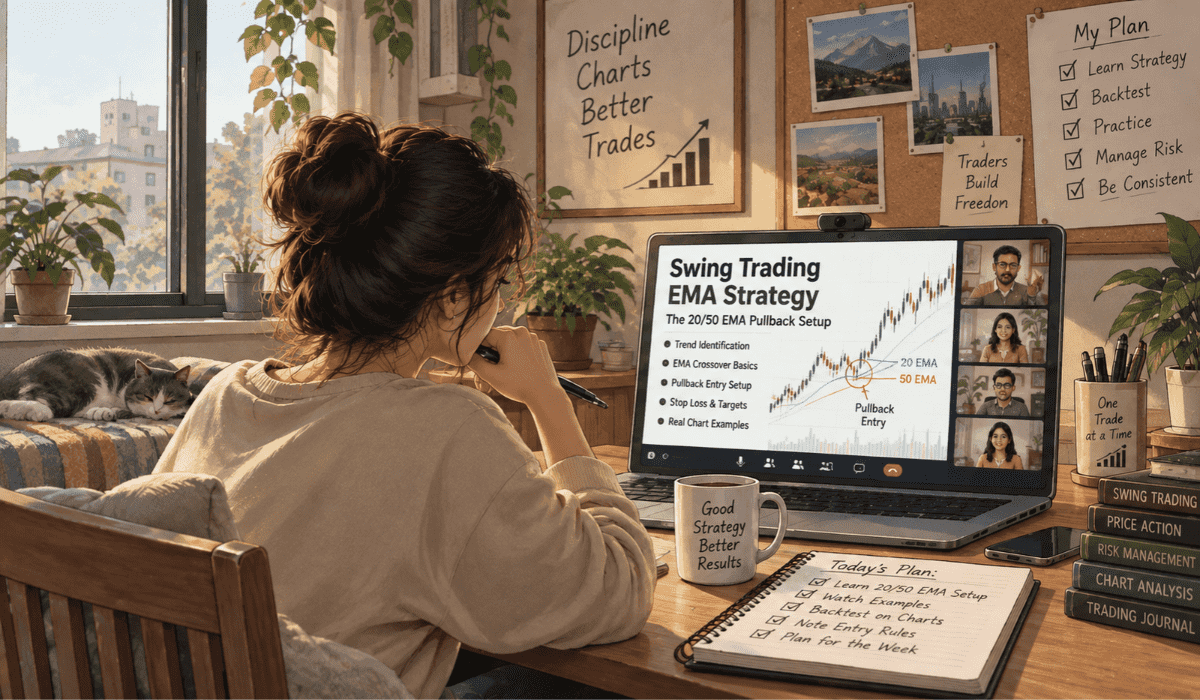
Traders often confirm this kind of bottom when price holds or reclaims a key moving average, a signal used in an EMA-based swing setup.
A swing trader buys around ₹1,505, expecting the stock to rally back toward its recent high near ₹1,610.
Over the next twelve trading days, the stock climbs to ₹1,600, and the trader exits.
That is the entire trade: one swing, roughly two weeks, with a defined entry and a defined exit.
An intraday trader might have entered and exited the same stock a dozen times over those twelve days.
A long-term investor might have simply held Infosys through the pullback without acting on it at all.
Swing Trading vs Intraday, Positional & Long-Term Investing
Understanding This Methodis easier once you see where it sits relative to other trading and investing styles.
Exploring advanced methodologies like Swing Trading with AI highlights how modern algorithms help participants quickly navigate these different asset classifications.
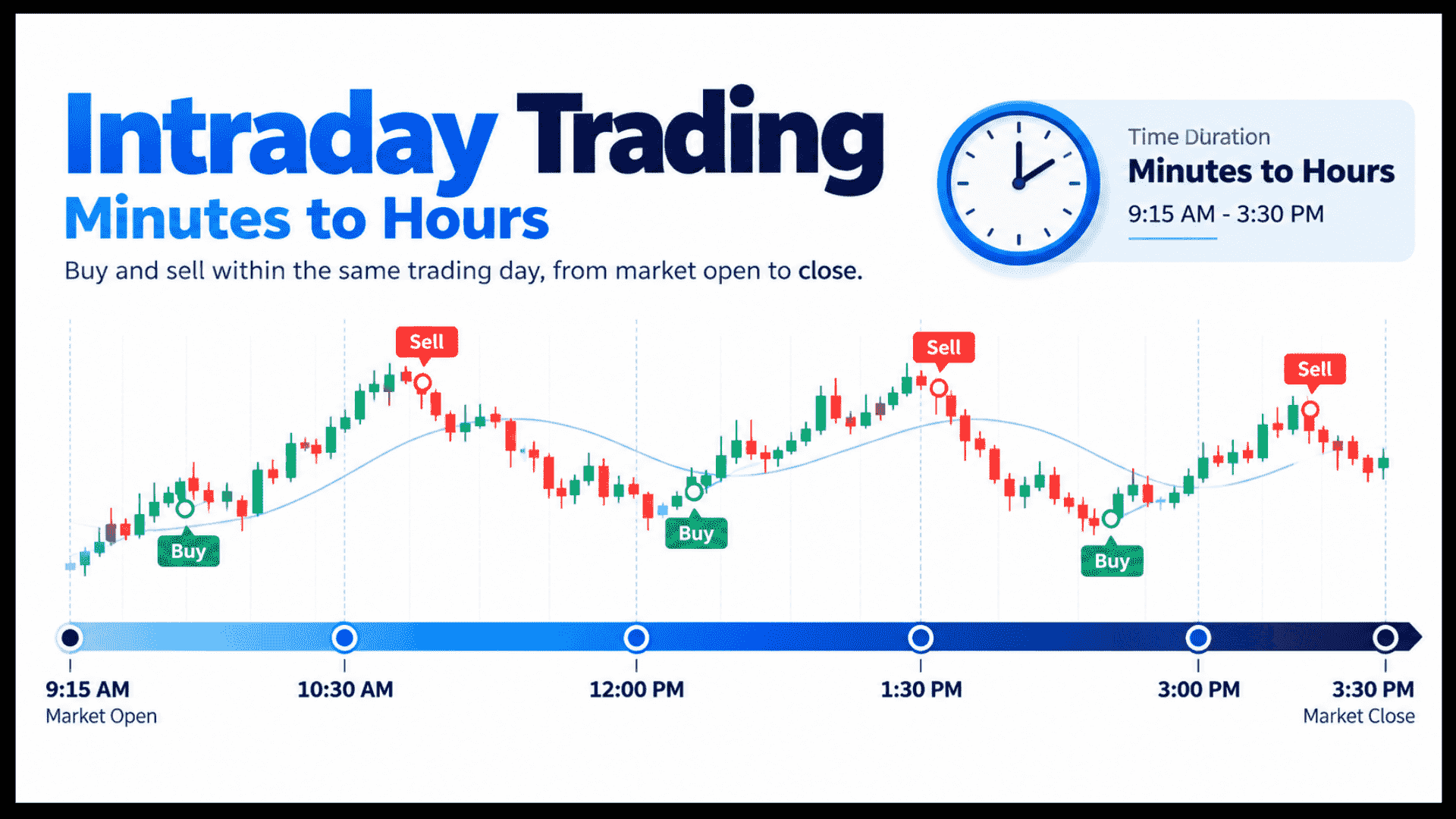
Intraday (day) trading: positions opened and closed within the same trading session, never held overnight.
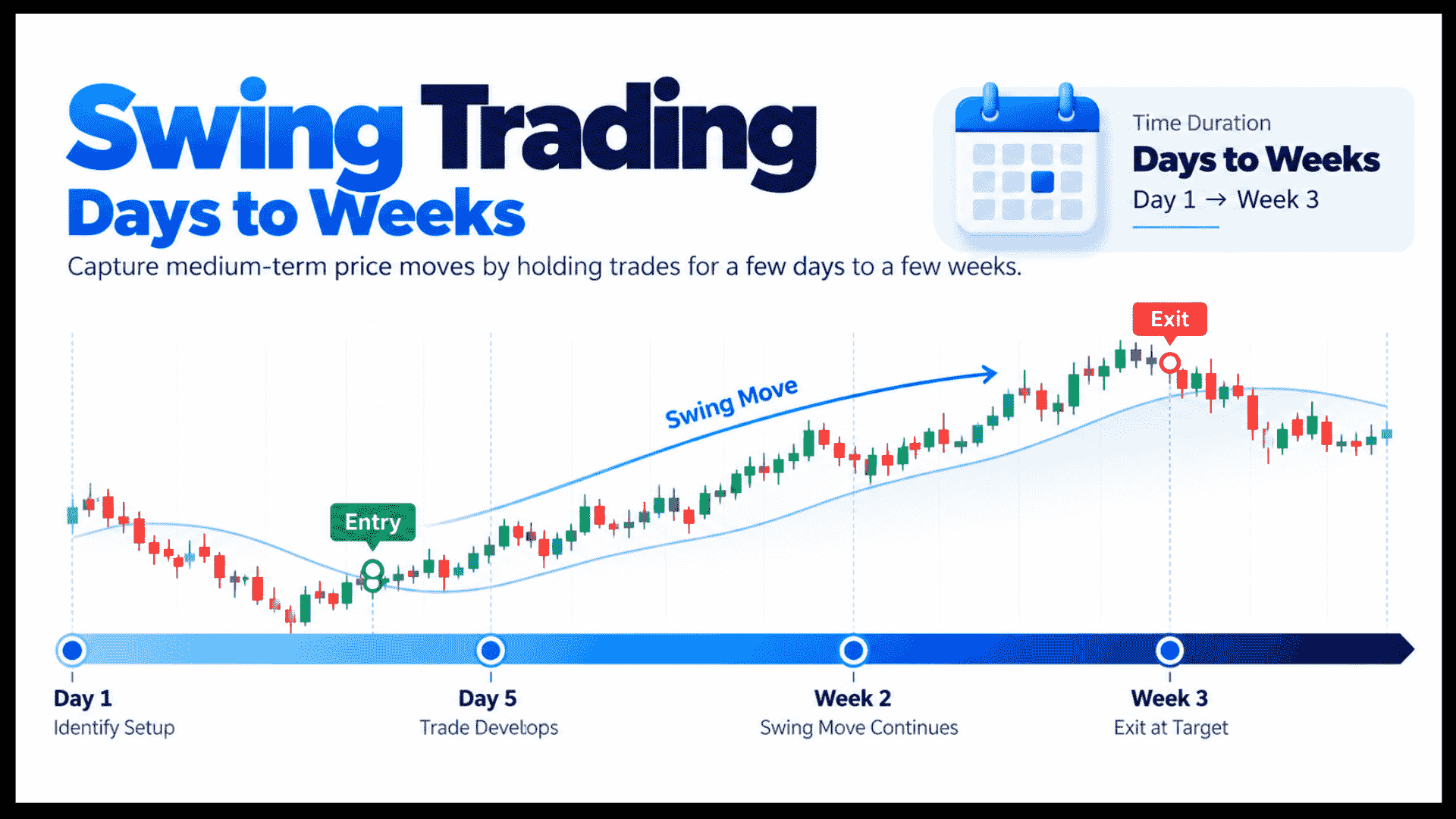
Swing trading: positions held for a few days to a few weeks, capturing one price swing within a broader trend.
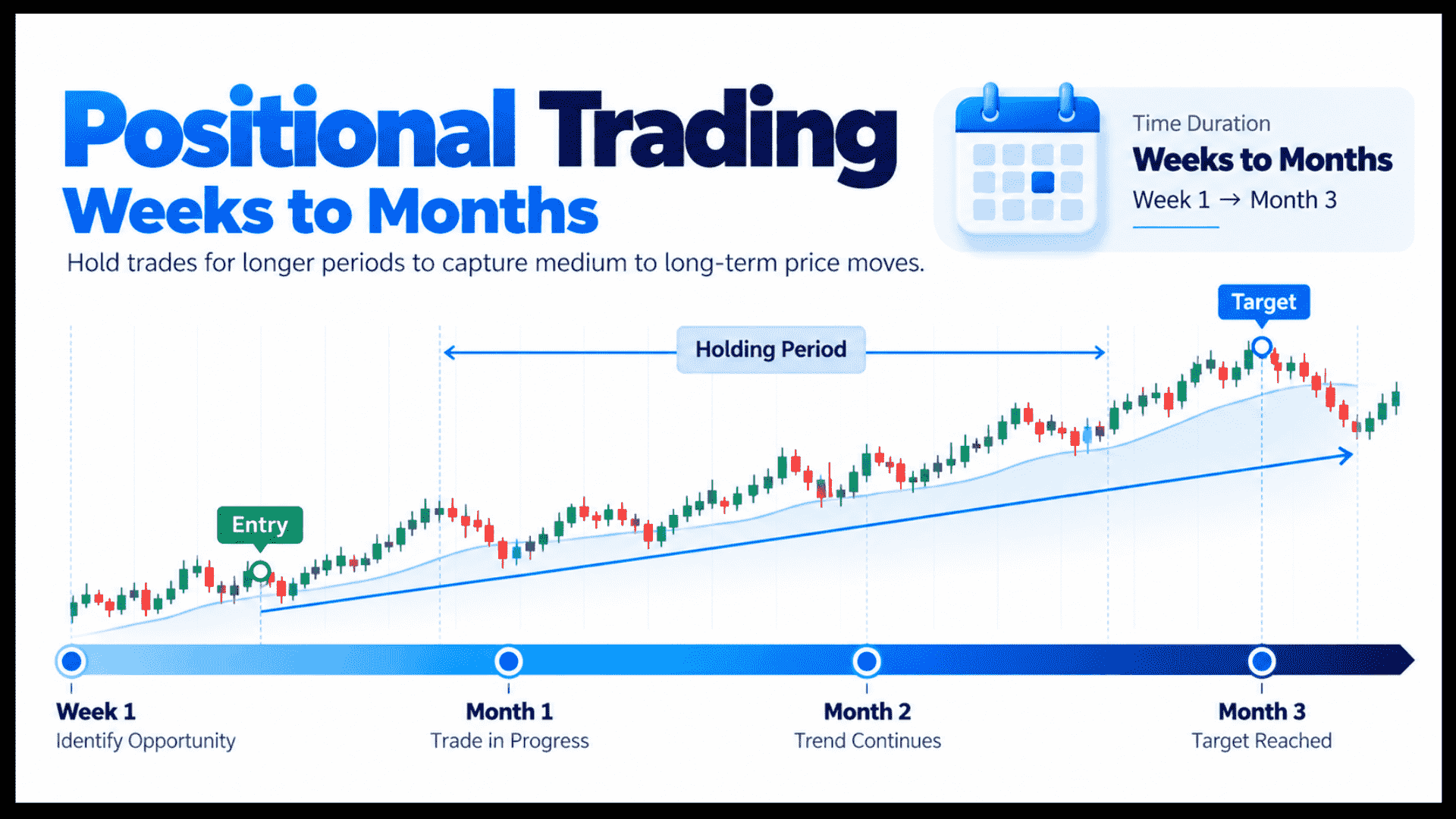
Positional trading: positions held for weeks to a few months, riding a larger portion of a trend.
Long-term investing: positions held for years, based largely on the underlying business rather than short-term price movement.
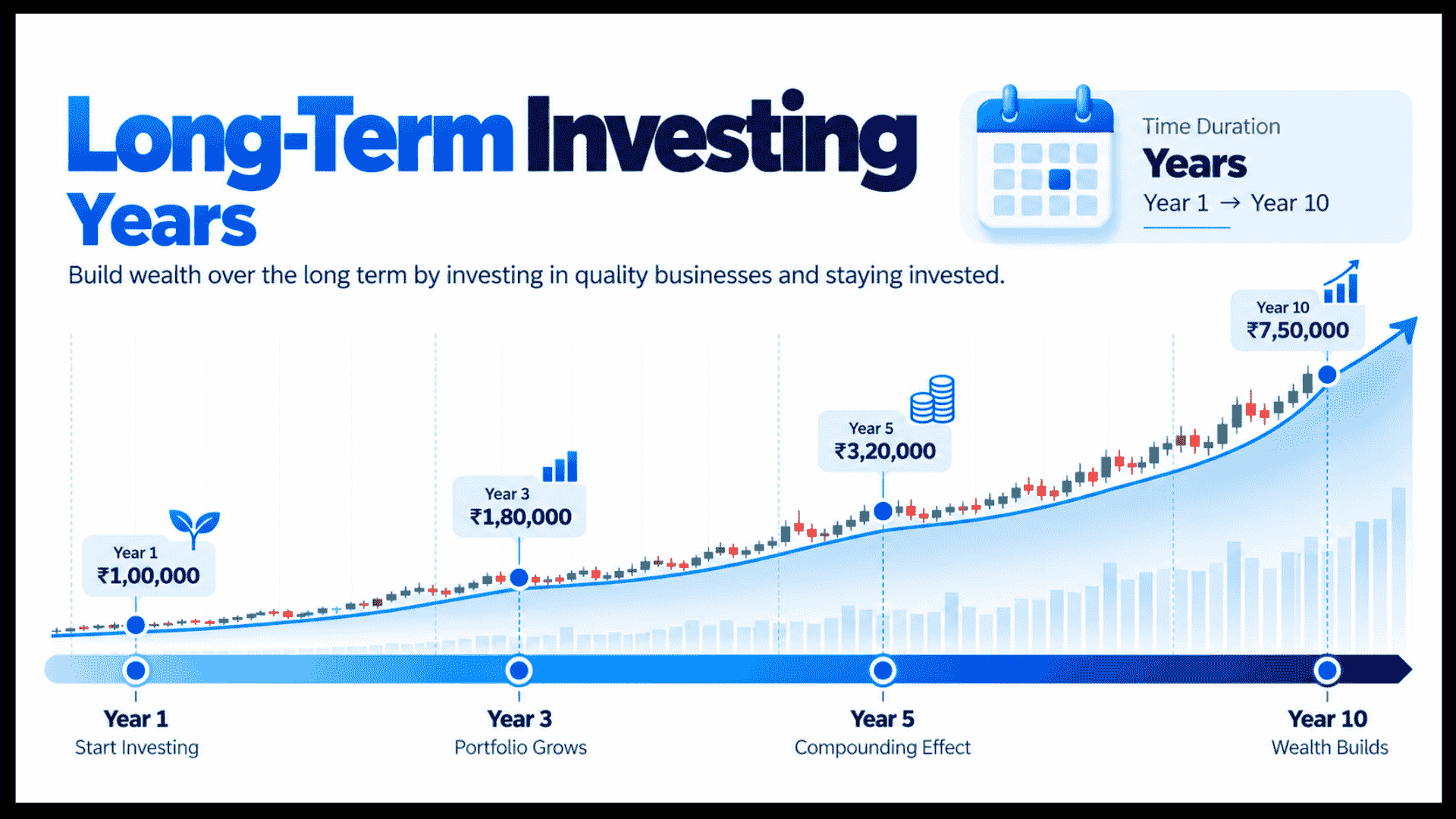
Swing trading sits deliberately in the middle of this spectrum. It requires more patience than intraday trading but far less than long-term investing.
That is exactly why it appeals to people who want to be actively involved without watching a screen all day. Most of that involvement comes through swing trading with technical analysis, reading charts rather than tracking every tick.
Why Swing Trading Exists as a Separate Trading Style
The stock market genuinely does not move in a straight line, even during a strong uptrend or a sustained downtrend.
That back-and-forth movement is not noise to be ignored. It is the entire opportunity swing trading is built around.
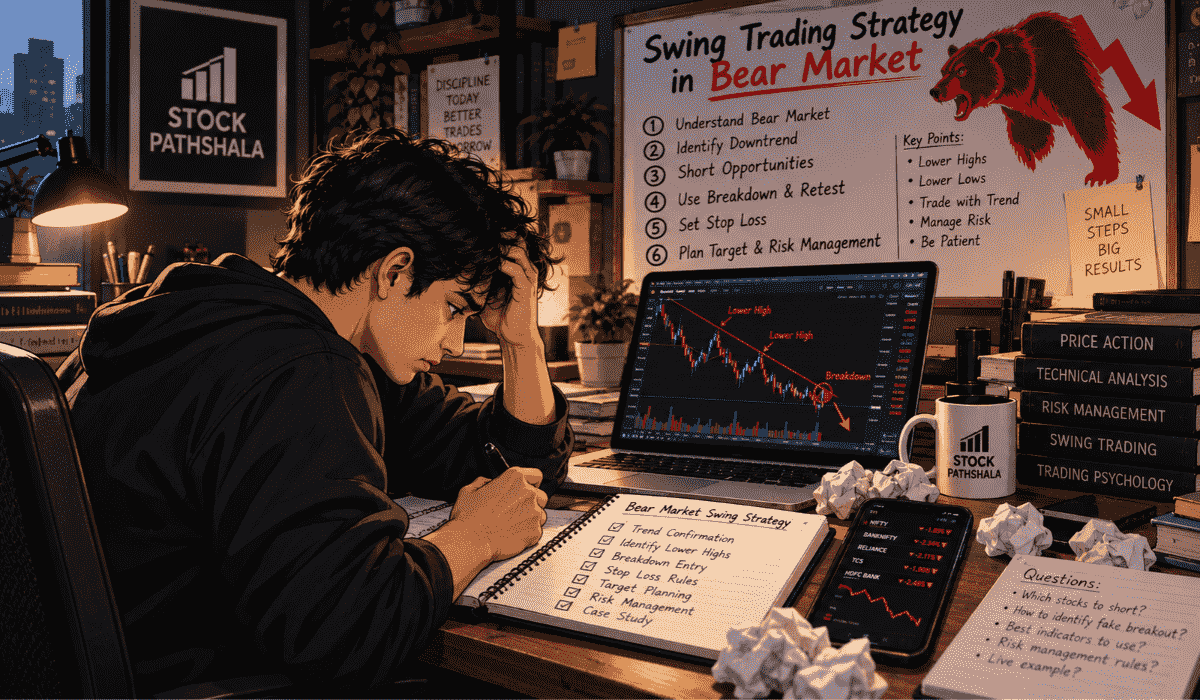
This is also why a swing trading strategy in bear market conditions can still work, since downtrends have their own swings too.
A long-term investor largely ignores these swings, correctly, because their thesis is about the business over years.
An intraday trader is too fast to capture a swing that plays out over a week, since they close everything by end of day.
This method exists precisely to capture the value in that middle ground, movements too slow for intraday trading and too fast for a buy-and-hold investor to act on.
What You Need to Start Swing Trading?
Contrary to what a lot of trading content implies, you do not need expensive software, ten monitors, or hours of free time during market hours. The basic requirements are:
A demat and trading account with a broker that supports the segment you plan to trade (equity, futures, or options, depending on your approach).
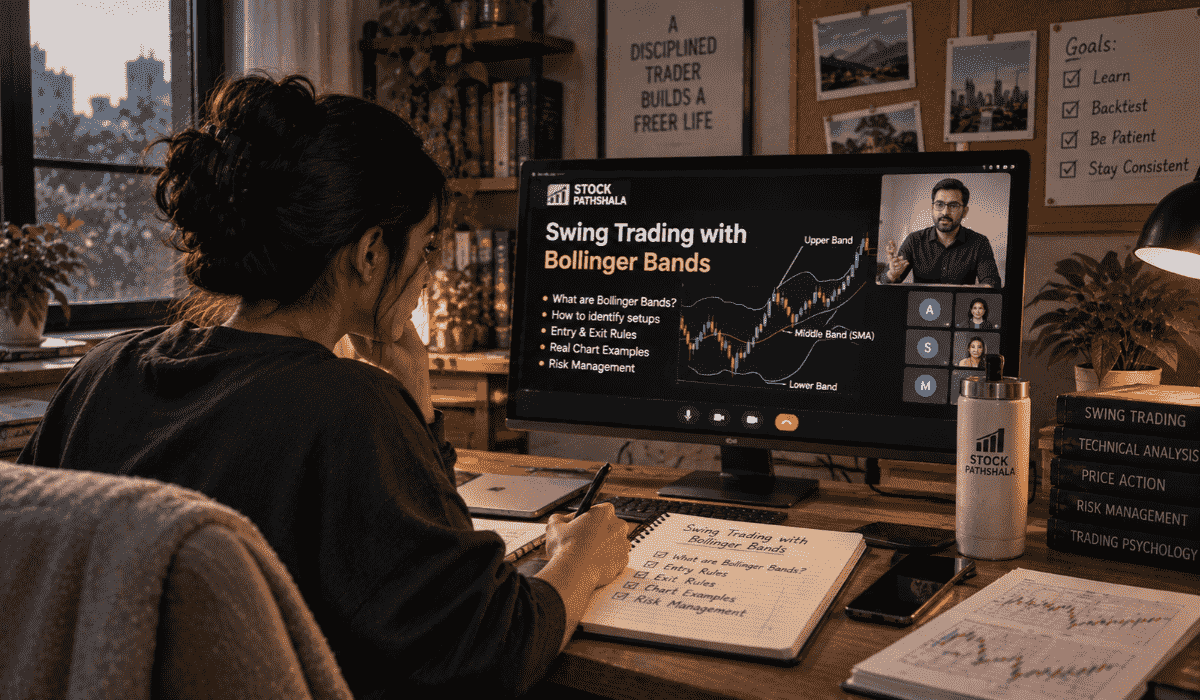
A charting platform to review daily charts, most of which are free at a basic level. Even basic versions usually support tools like swing trading with Bollinger Bands.
Fifteen to twenty minutes a day, typically after market close, to review your watchlist and plan the next session’s orders.
A defined set of rules for entry, stop loss, and exit, so decisions are not made in the moment under pressure.
That last point matters more than any tool or platform. This Method without a defined plan is not really this method
It is guessing on a slightly longer timeframe.
Is Swing Trading Right for You?
This Method tends to suit people who want active, regular involvement in the market but cannot or do not want to watch price movement all day.
Working professionals, students, and anyone with a fixed daytime schedule often find this style fits their life better, since the core analysis happens outside market hours.
It does not suit someone looking for a passive, hands-off approach.
Implementing consistent swing trading rules requires daily discipline and a structured routine.
It still requires a consistent routine: checking charts, tracking positions, and reviewing setups.
Someone wanting a truly passive approach is generally better served by long-term investing or systematic mutual fund investing instead.
If you do fit the profile, the natural next question is where to learn swing trading in a structured, practical way.
Risks of Swing Trading Beginners Underestimate
Swing trading is not lower risk simply because it needs less daily attention than intraday trading.
Positions are held overnight and across weekends, which exposes them to gap-up or gap-down moves driven by news or global events while the market is closed.
That overnight exposure is a genuine trade-off against the reduced screen time, not something This Method avoids entirely.
Proper risk management, defined stop losses and sensible position sizing, is what makes this trade-off manageable rather than dangerous.
We cover that in full in our dedicated post on swing trading risk management.
3 Common Swing Trading Myths
A lot of beginners avoid swing trading or approach it the wrong way because of ideas they picked up from social media and trading forums.
Here are three of the most common swing trading myths, and what actually holds true in practice.
“Swing trading is just gambling on short-term moves.” Is it?
Not really. Swing trading is based on reading trend, support and resistance, volume, and momentum, the same factors that drive longer-term price movement.
It simply applies them over a shorter window with defined rules.
For example, traders use Fibonacci retracement levels to mark likely pullback zones in advance, rather than guessing where price might turn.
“You need to watch charts all day.”
This is the most common misconception, and it is simply not true.
Since positions are held for days to weeks, checking charts once a day, typically after market close, is the standard routine, not continuous monitoring.
“It’s just day trading with extra steps.”
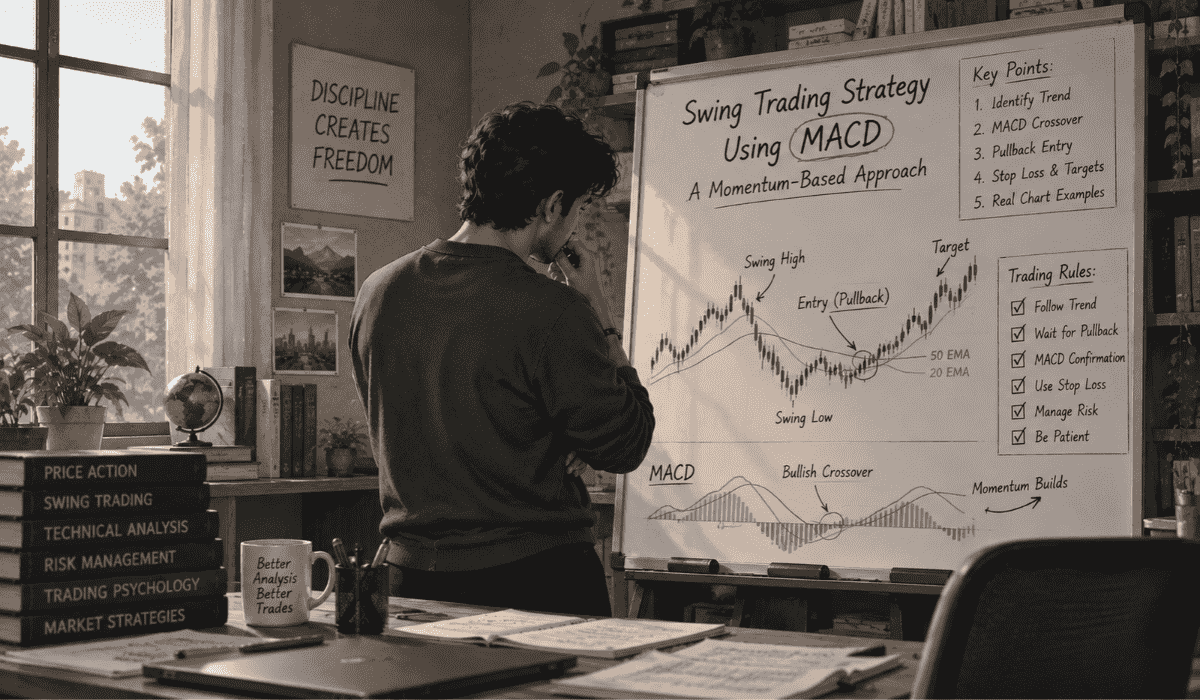
The two styles share some technical tools, such as those used in a swing trading strategy using MACD.
But they are built around fundamentally different holding periods, risk exposures (overnight gaps versus none), and even different psychological demands.
We cover this in detail in our swing trading vs day trading comparison.
The Swing Trading Meaning Most Definitions Miss
It is worth sitting with the swing trading meaning a little longer than a one-line definition allows.
The “why” behind it explains a lot about why this style has grown so popular among Indian retail traders specifically.
Stock prices, even within a strong trend, spend a meaningful amount of time moving sideways or pulling back before continuing.
A trader who only participates during the strongest, most obvious trending days misses a large portion of what the market offers across a typical month.
Swing trading is built to capture value from those pullbacks and consolidations too. The cup and handle swing trading strategy is one well-known example built around exactly this kind of consolidation.
This is why trading tends to produce more frequent opportunities than long-term investing, which waits years for a thesis to play out.
It also demands far less constant attention than day trading, which reacts to every intraday tick.
It occupies a genuinely useful middle position, not as a compromise, but as its own distinct approach with its own strengths.
Where Does Swing Trading Fit in Your Bigger Financial Plan?
For most people, swing trading is not meant to replace their entire approach to building wealth.
A common, sensible structure: a core long-term investment portfolio, often through mutual funds or direct equity, handled with a buy-and-hold mindset and largely left alone.
Alongside it sits a smaller, clearly defined portion of capital dedicated to active swing trading.
This way, long-term financial goals do not depend entirely on trading skill developing quickly.
The Methos portion offers a genuine way to engage with the market using capital you can afford to actively manage and, if individual trades go wrong, afford to lose within your defined risk limits. Many traders speed up this learning curve through swing trading mentorship rather than trial and error alone.
Ready to Go From Understanding It to Actually Trading It?
Knowing what swing trading is gets you halfway there
Actually applying it, on real charts, with a structured plan, is the other half.
Our Swing Trading Classes take you from this exact starting point through to live, guided setups on Indian stocks.
Conclusion: Swing Trading in One Simple Picture
Swing trading is a middle-ground trading style where you hold positions for a few days to a few weeks to capture one meaningful price . It needs far less screen time than intraday trading but more involvement than long-term investing. Emphasizing strict swing trading risk management is essential when holding positions across volatile weekends and market holidays.Overnight gaps are a real risk, so defined stop losses and sensible position sizing are non-negotiable. For most people, it works best alongside a core long-term portfolio, not as a replacement. If you want to learn it the right way, with real charts and structured guidance, our swing trading classes are a practical next step.
Frequently asked questions
Before investing capital, invest your time in learning Stock Market.
Fill in the basic details below and a callback will be arranged for more information: