



Most swing trading content assumes stocks are going up.
A swing trading strategy in a bear market needs a genuinely different playbook, not just the same setups flipped upside down, and there is one India-specific rule that trips up a lot of traders here that we need to cover first.
Unlike global markets where holding a short position in cash equities is routine, Indian regulations forbid carrying cash-market shorts overnight.
If you don’t know how to navigate futures and options for multi-day downtrends, your trades will get force-closed before they ever play out.
Let’s break down the exact rules, setups, and risk adjustments you actually need to survive and profit when the broader market turns red.
Why You Can’t Carry Short Positions Overnight in Indian Cash Markets?
In the Indian cash equity segment, you cannot carry a short position overnight.
Traders exploring what is swing trading often assume overnight shorting works the same way globally, but local regulations differ.
If you sell a stock short in the cash market, you must square it off the same day, or it gets auto-converted, which most brokers will not even allow past intraday hours in practice.
That means a genuine multi-day swing short in India has to be done through futures or put options, not by shorting the stock itself in your regular demat holdings.
This single fact changes the entire approach compared to markets like the US, where shorting a stock in cash for weeks is routine.
What Does a Bear Market Actually Look Like?
A bear market is generally defined as a fall of 20% or more in a major index like the Nifty 50 or Sensex from its recent peak.
It is sustained over weeks or months, rather than a single sharp correction that recovers quickly.
Why It Is Not Just a Bull Market in Reverse
Bear markets are not just “the opposite of a bull market.” They behave differently.
Rallies tend to be sharper and shorter-lived. Panic-driven drops tend to be steeper than the slow grind up that preceded them.
Volatility overall runs higher.
Many modern quants and retail investors are now incorporating Swing Trading with AI to map out these sudden volatility shifts before they break support.
How to Trade the Bearish Pullback Setup in a Downtrend
When shifting strategies from bull markets to a bearish environment, traders must effectively mirror classic breakout setups to capture downward momentum.
By tracking structural weaknesses, identifying temporary relief rallies, and timing entries correctly, you can systematically profit from declining price action.
Flipping the Trend-Following Setup for a Downtrend
The core logic of trend-following swing setups still applies, just mirrored.
Applying a swing trading with technical analysis approach helps traders identify these structural shifts when momentum changes direction.
The Bearish Pullback Setup, Step by Step
Downtrend condition: 50-day moving average below the 200-day moving average, price trading below the 50-day average.
You also want a clear pattern of lower highs and lower lows.
Entry trigger: Price forms a bearish pullback (a “dead cat bounce” toward resistance, often the 20 or 50 EMA from below), the same levels a swing trading EMA strategy relies on.
It then reverses back down, confirmed by a bearish candle. A bearish crossover, as used in a swing trading strategy using MACD, can add extra confirmation.
Entry: Short via futures or a put option as the bearish candle closes, or on confirmation the following session.
Stop loss: Just above the recent swing high of the bounce.
Target: The prior swing low, or a Fibonacci extension if the move looks likely to break further.
The same tools used in swing trading with Fibonacci retracements help map these levels.
Worked Example: Tata Steel’s Failed Bounce
Suppose Nifty has been in a confirmed downtrend for two months, trading below its falling 50-day moving average.
A stock like Tata Steel bounces from ₹135 up toward ₹148, right into resistance near its falling 20 EMA, and prints a bearish engulfing candle at ₹147.
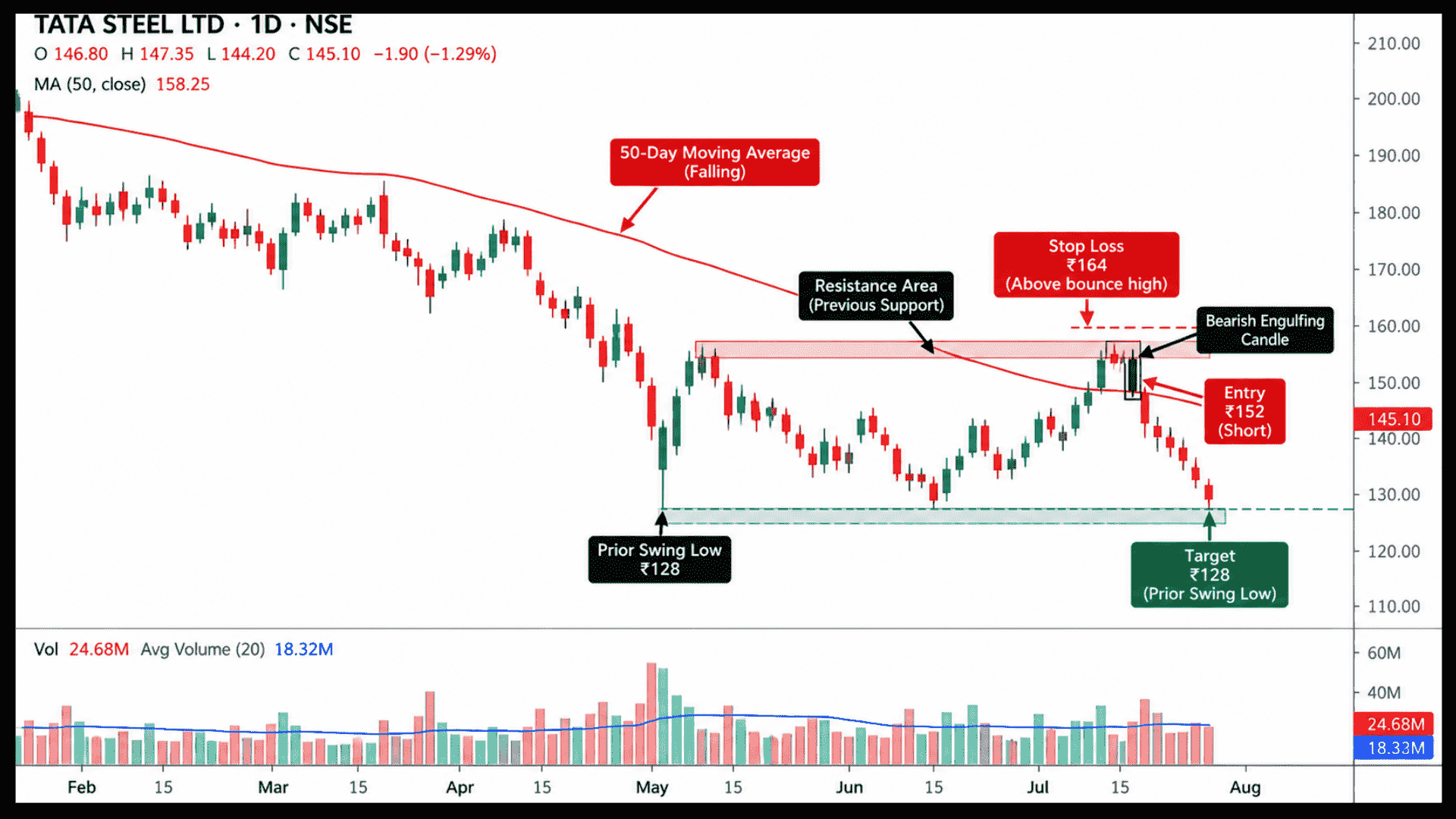
Since carrying this short overnight in cash is not possible, you take the view through a Tata Steel put option or futures contract instead.
You set your mental invalidation level at ₹152, just above the bounce high.
Over the following ten sessions the stock falls to ₹128, and you book the trade.
Which Defensive Sectors Hold Up Best in a Bear Market?
Not every stock falls equally hard in a bear market.
FMCG, pharma, and other defensive sectors historically tend to fall less than high-beta sectors like metals, realty, and small-cap-heavy segments.
If you are looking for relative strength swing setups even inside a broader downtrend, these sectors are usually where they show up first.
Adjusting Risk Management for a Bear Market
When market conditions shift into a sustained downtrend, standard capital allocation and stop-loss rules can quickly drain your trading account if left unchanged.
Widening daily price ranges and heightened volatility demand a disciplined overhaul of your risk parameters to protect hard-earned capital. By dynamically reducing position sizes, keeping higher cash reserves, and identifying continuation structures early, traders can navigate turbulent market phases safely.
Shrink Your Position Size
Position sizing that worked fine in a calm bull market often needs to shrink in a bear market, simply because average daily ranges widen.
A stop loss sized for normal volatility can get hit on ordinary noise when the whole market is swinging harder than usual.
Watching band width, as in swing trading with Bollinger Bands, is one simple way to see volatility expanding.
Let Cash Do Some of the Work
Cash allocation matters more too.
Sitting partially in cash and waiting for high-conviction setups, rather than staying fully deployed, tends to serve swing traders better.
Embracing conservative swing trading risk management allows market participants to preserve capital safely until clear downside momentum returns.
This applies once a downtrend is confirmed across the broader market, not just in an individual stock.
The Bearish Pattern Hiding in Plain Sight
The mirror image of the classic cup and handle, sometimes called the inverse cup and handle, appears more frequently during sustained downtrends.
Recognizing these distinct swing trading patterns early can give traders a substantial edge before a major support level breaks.
It is traded as a bearish breakdown continuation pattern.
Traders often look for confirmation here much like they would evaluate a standard cup and handle swing trading strategy during a bullish phase.
If you want the full mechanics of the bullish version first, our post on cup and handle swing trading strategy covers it in detail, including how the logic flips for the bearish variant.
Costly Mistakes to Avoid When Using a Swing Trading Strategy in a Bear Market
Navigating a declining market requires unlearning the habits formed during prolonged bull runs, as standard risk assumptions will quickly backfire.
Falling into traps like bottom-fishing prematurely or neglecting derivative regulations can instantly erase a trading account.
Review the critical pitfalls below to ensure your capital remains protected:
Buying Every Dip
Trying to “buy the dip” on every fall, treating a bear market pullback the same way you would a bull market pullback, is probably the most expensive mistake.
Bear market bounces fail more often than they succeed, and catching a falling stock too early is a fast way to give back weeks of gains from earlier trades.
Forgetting the F&O Requirement
Ignoring the futures and options requirement for carrying a short past a single session is the second, more basic mistake.
It usually ends with an unwanted auto square-off at a bad price.
Puts or Futures: Which Fits a Bearish Swing Better?
Futures give you a leveraged, direct short exposure, but the risk is technically unlimited if the trade goes against you, since a stock can theoretically keep rising.
A put option caps your maximum loss to the premium paid, which is why many swing traders new to bearish setups prefer starting there rather than with futures.
If you are still building the basics, a swing trading strategy for beginners is worth mastering before either.
The Time Decay Catch
The trade-off is that a put option loses value from time decay even if you are directionally right but the move takes longer than expected.
Choosing a strike price and expiry with enough time built in for the swing to develop, rather than the cheapest, shortest-dated option available, matters more than most beginners initially realise.
How Does a Bear Market Rally Trap Traders?
Bear market rallies, sometimes called relief rallies, can be sharp and fast.
They occasionally recover 10% or more of the prior fall in a matter of days before the downtrend resumes.
These rallies are exactly what tempt traders into thinking the bear market is over and buying back in too early.
The bearish pullback entry setup described above is partly designed around this exact trap.
Waiting for the bounce to actually fail and reverse at resistance, rather than assuming every fall is “the bottom,” is what separates a planned bearish swing entry from a reactive guess.
Momentum readings from a swing trading strategy using RSI can help confirm when a bounce is losing steam.
Does Your Stock Chart Agree With the Index in a Bear Market?
An individual stock chart can look tempting even while the broader index is falling hard.
Checking Nifty and Bank Nifty’s own trend before taking any bearish or bullish swing trade matters more in a confirmed bear market than in a calm bull market.
Broad market weakness tends to drag down even fundamentally decent stocks during genuine downturns.
Want Guidance Trading Both Directions of the Market?
Bear markets punish traders who only know how to trade rising stocks.
Our swing trading classes cover both bullish and bearish setups live, so you are not left guessing when the broader trend actually turns.
For closer, ongoing support, swing trading mentorship is also available.
Conclusion
A swing trading strategy in a bear market works when you respect what changes.
In India, multi-day shorts must go through futures or put options, never cash equity.
Trend-following logic still holds, just mirrored: wait for a bounce to fail at resistance, keep stops above the swing high, and target the prior low.
Shrink position sizes as volatility widens, hold more cash, and check the Nifty’s trend before every trade.
Above all, avoid buying every dip; bear market bounces fail more often than they succeed, and patience is what protects your capital.
Frequently asked questions
Before investing capital, invest your time in learning Stock Market.
Fill in the basic details below and a callback will be arranged for more information: