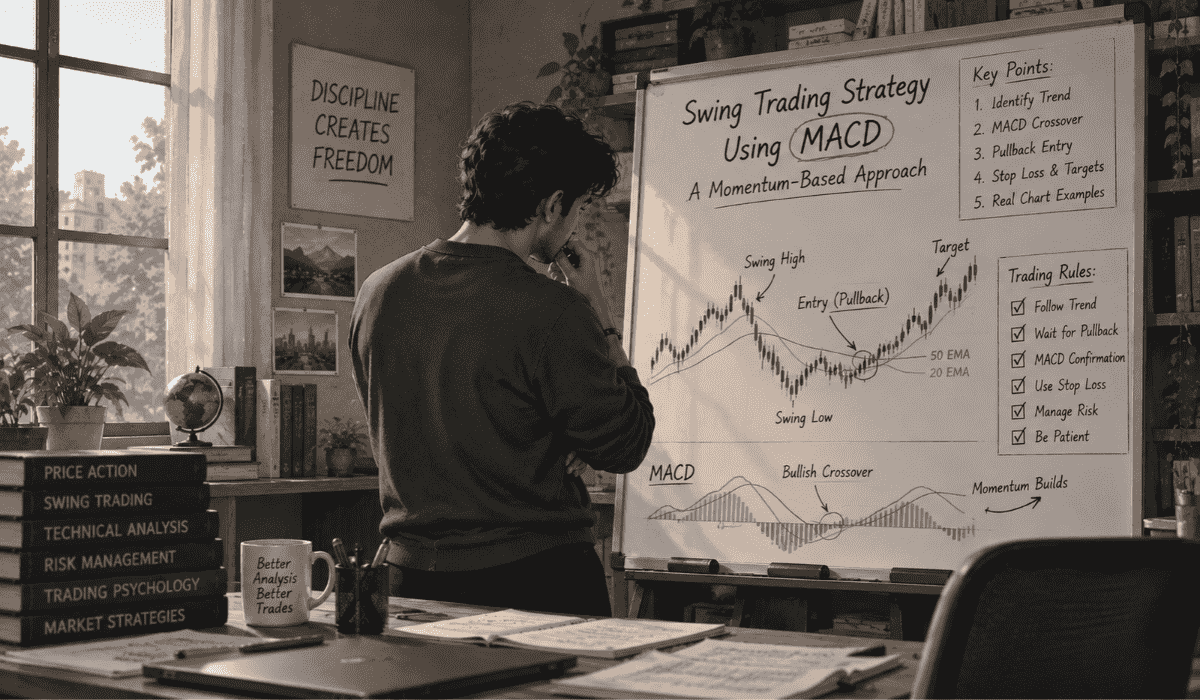



Strategies get all the attention in trading content. Swing trading rules rarely do, which is strange.
The rules you follow between trades matter just as much as the setup you use to enter one.
This is not a post about position sizing or stop loss placement specifically. We cover that in full in our swing trading risk management guide.
If you are new to the approach itself, start with what is swing trading first.
This post is about the broader discipline rules: when to trade and when not to.
It also covers the habits that quietly separate consistent swing traders from everyone else.
Rule 1: Are You Trading the Setup or Just the Feeling?
If a trade does not meet your predefined entry criteria, it is not a trade.
That could be a confirmed EMA pullback, an RSI dip within a trend, or a clean breakout on volume.
Adhering strictly to established swing trading rules ensures that your capital is only deployed when these high-probability conditions align.
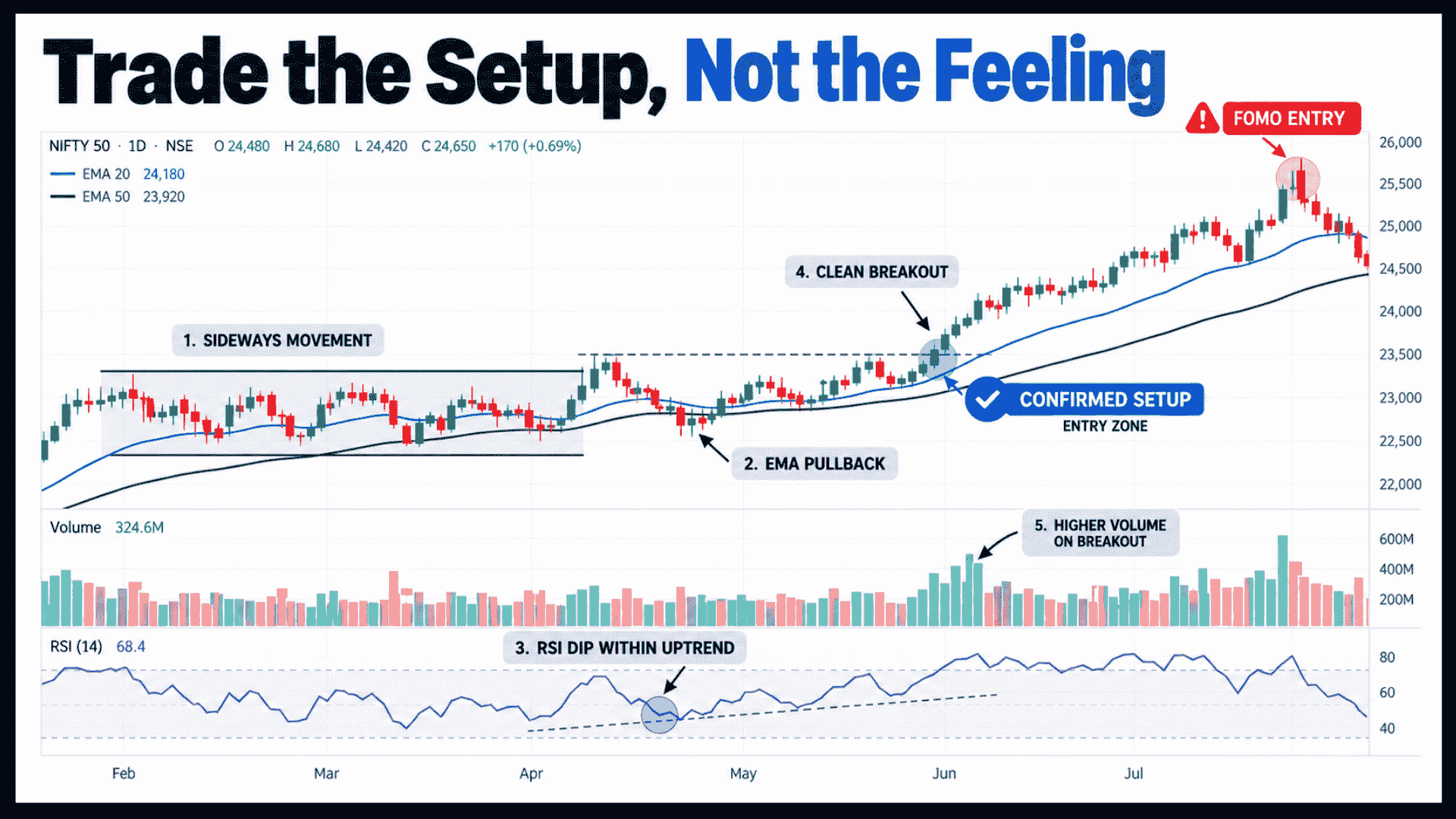
Anything else is a guess wearing a trading strategy’s clothes.
These setups come straight from swing trading with technical analysis, where every entry needs a clear, checkable reason.
This sounds obvious written down. In practice, it is the rule broken most often.
It usually happens when a stock has already moved. A trader then chases it in without the actual setup, purely out of fear of missing out.
Rule 2: Why Swing Trading Rules Favour a Confirmed Trend Over a Predicted One
Never enter a trade based on where you think a stock’s trend is about to go. Enter based on where the trend already is.
Swing trading setups are built around confirmation, not prediction of what might happen next.
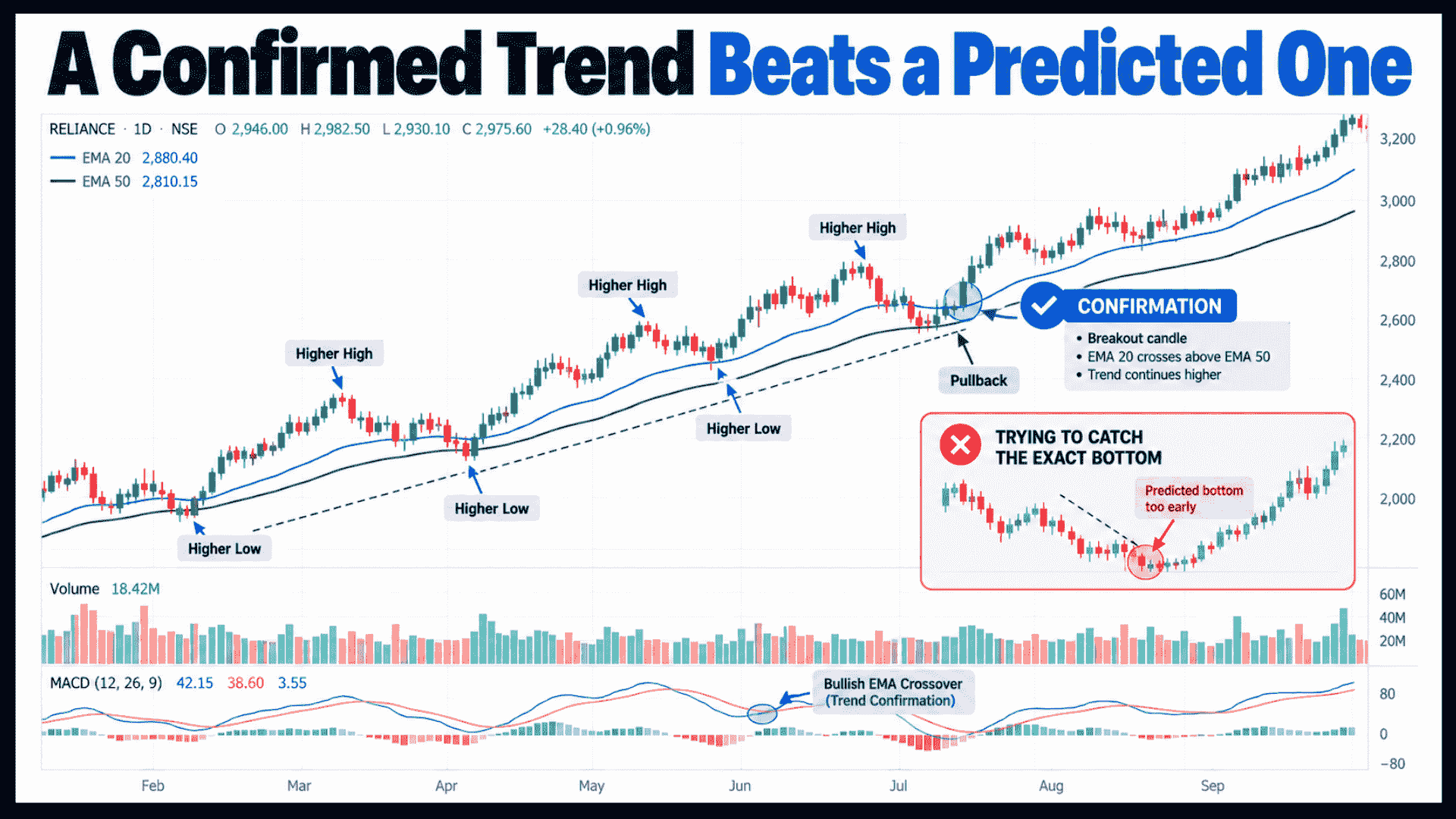
That means a completed pullback, a closed breakout candle, or an actual crossover.
Trying to catch the exact bottom or the exact top consistently is a losing game, even for experienced traders.
Waiting for confirmation costs a small part of the move. But it dramatically improves the odds the trade actually works.
Rule 3: How Long Should This Trade Actually Take?
Before entering, have a rough sense of how long this specific setup typically takes to play out.
An EMA pullback trade might resolve in five to ten sessions. A cup and handle swing trading strategy breakout might take longer to reach its measured target.
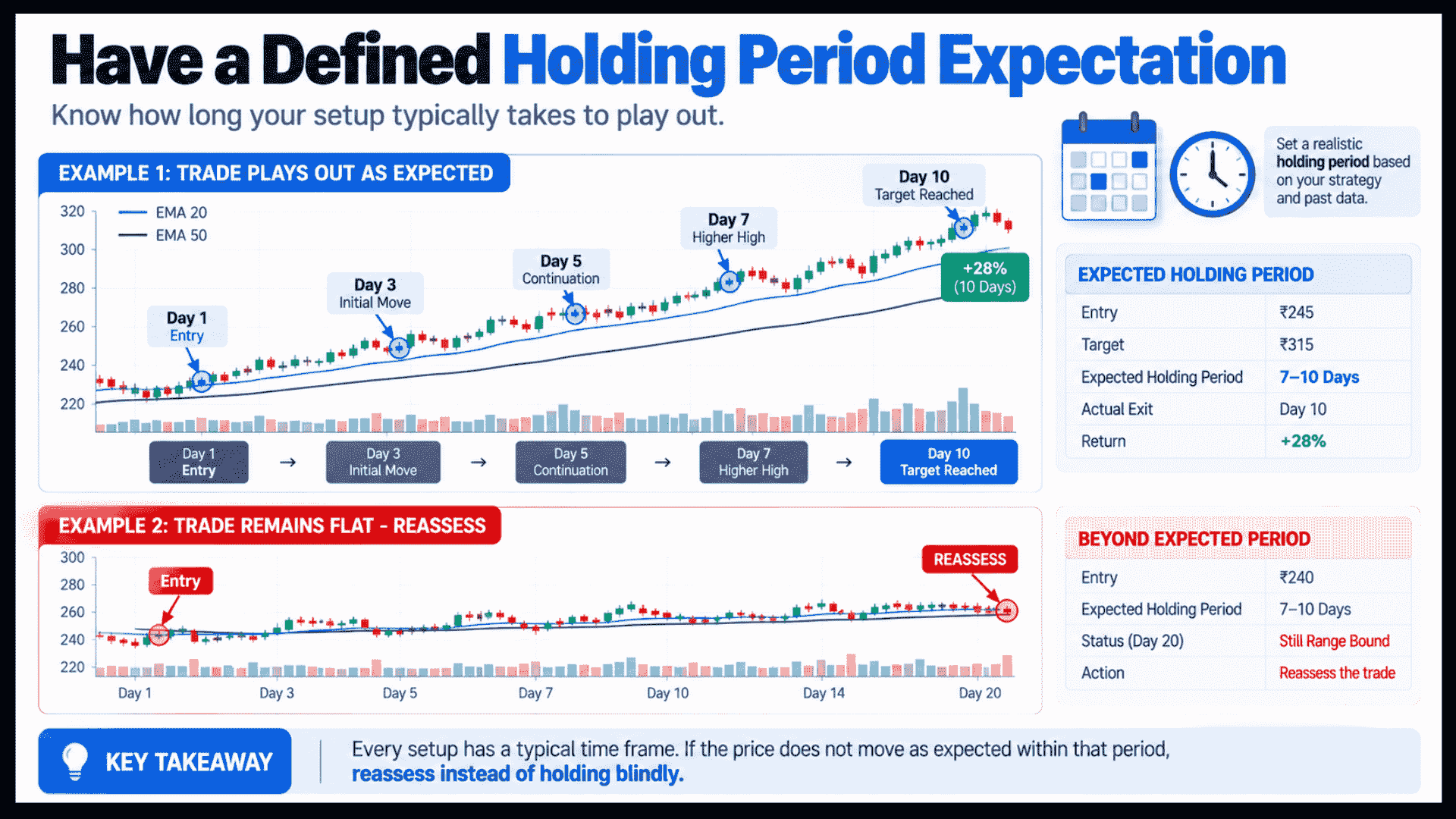
Sometimes a trade goes nowhere for far longer than the setup usually takes.
That trade is telling you something, even if it has not hit your stop loss yet.
It may be time to reassess, not necessarily exit immediately. At least revisit whether the original thesis still holds.
Rule 4: Stop Trading Just to Stay Busy
Good swing trading setups do not appear every single day.
On most days, the honest and disciplined answer to “Should I take a trade today?” is no.
Some traders still force a trade on a mediocre setup just to feel productive.
This is often a day-trading mindset carried into swing trading, even though the difference between swing trading and day trading lies largely in timeframe and trade frequency.
Others take a weak trade simply because they haven’t traded in a few days.
Either way, it adds risk without adding any real edge.
For most swing traders, four to six well-planned trades a month is a realistic pace, not four to six a week.
Rule 5: What Is the Broader Market Telling You First?
An individual stock can look technically perfect on a given day.
Yet the broader market, Nifty or Bank Nifty, may be falling sharply that same day.
Broad market weakness tends to drag down even good individual setups.
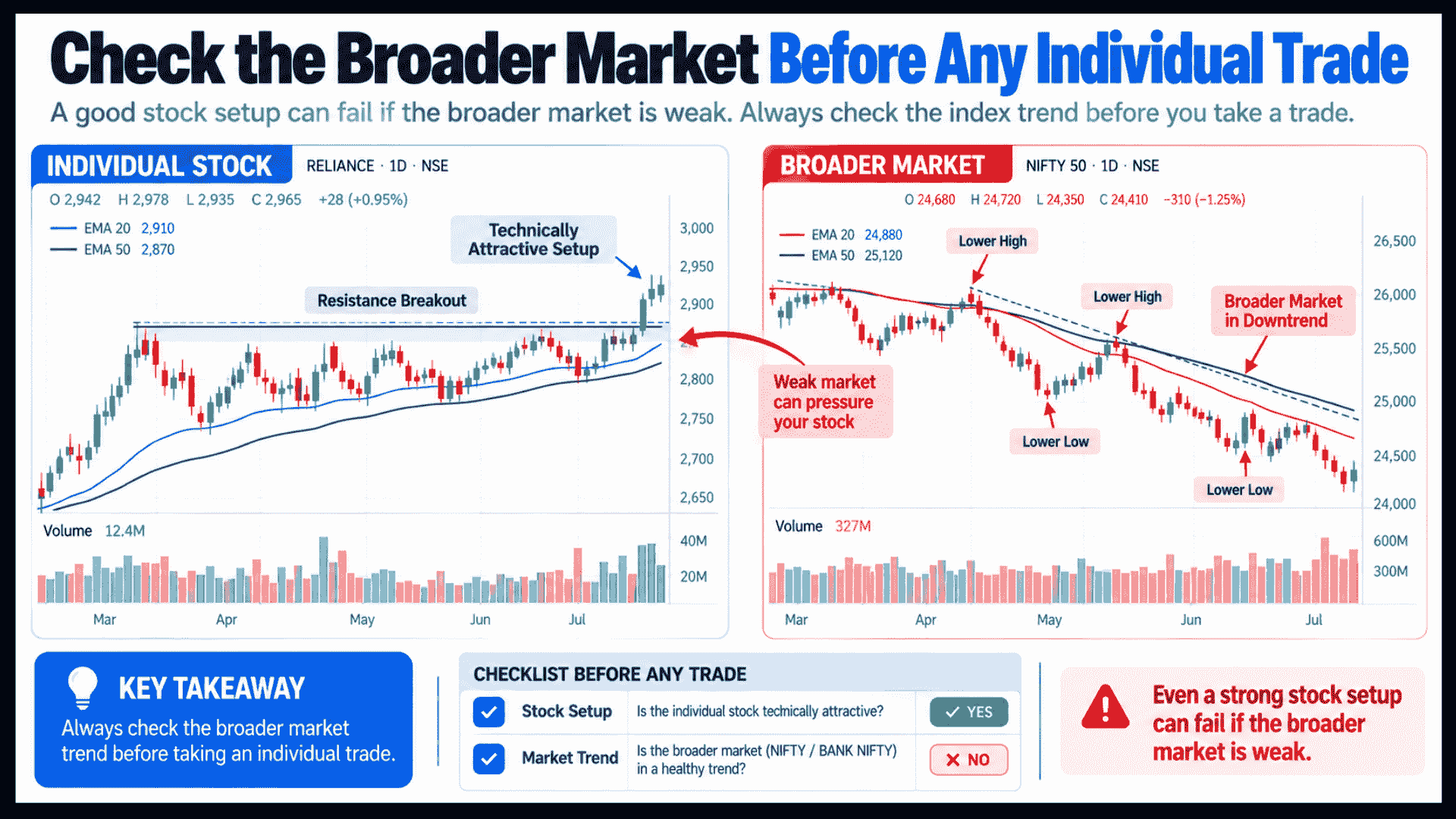
That is why a separate swing trading strategy in bear market conditions is worth having.
Checking the index trend before committing to any trade prevents a lot of avoidable losses.
Rule 6: Your Trading Journal Knows What You Don’t
Every trade, win or loss, should be logged with the setup used and the entry and exit price.
Also note the reasoning at the time and what actually happened.
This is not optional bookkeeping.
Modern practitioners increasingly leverage tools like Swing Trading with AI to automate pattern recognition and accelerate post-trade reviews.
It is the single fastest way to learn which of your setups genuinely work.
Tracking the success rate of different swing trading patterns in your log allows you to refine your entry criteria over time.
It also shows which ones only feel like they work.
Review this journal monthly and honestly. It tends to reveal patterns a trader would never notice trade by trade in the moment.
Examples include consistently exiting winners too early or ignoring the broader market trend rule above.
Rule 7: Decide Your Exit Before You Enter, Not Mid-Trade
You might exit at a fixed target or trail your stop as the trade develops.
You might also exit after a set number of sessions, regardless of price.
Decide which one applies to this specific trade before you enter it.
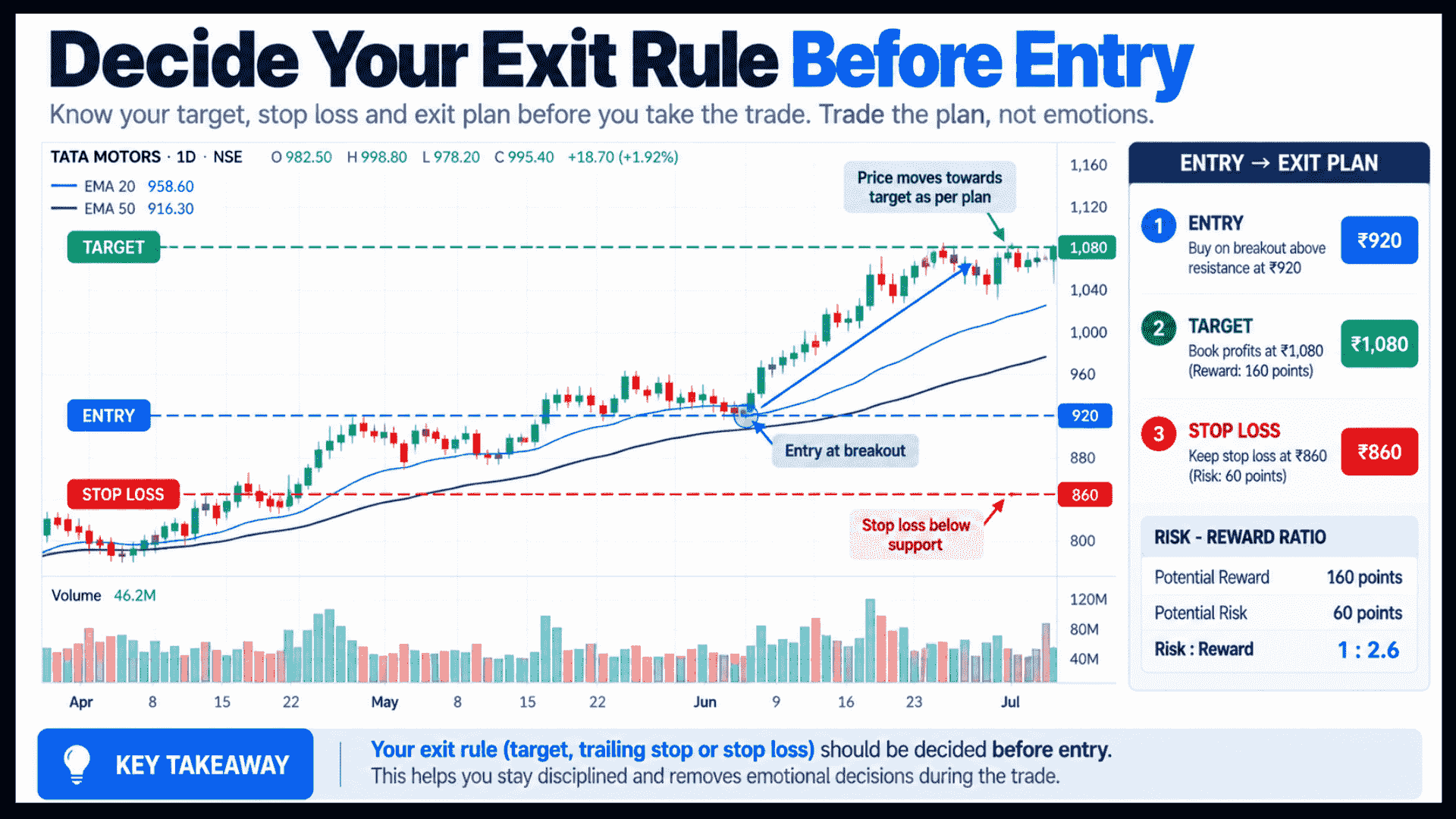
Changing your exit logic mid-trade is one of the more expensive habits a swing trader can develop.
It is usually driven by greed as a position runs up, or fear as it dips slightly.
Rule 8: Can You Lose Money and Still Be Doing It Right?
No set of swing trading rules eliminates losing trades.
Even a genuinely strong strategy loses regularly, often 40 to 55 percent of the time depending on the setup.
A single loss that respects your predefined stop loss is the system working correctly. It is not a sign the strategy has failed.
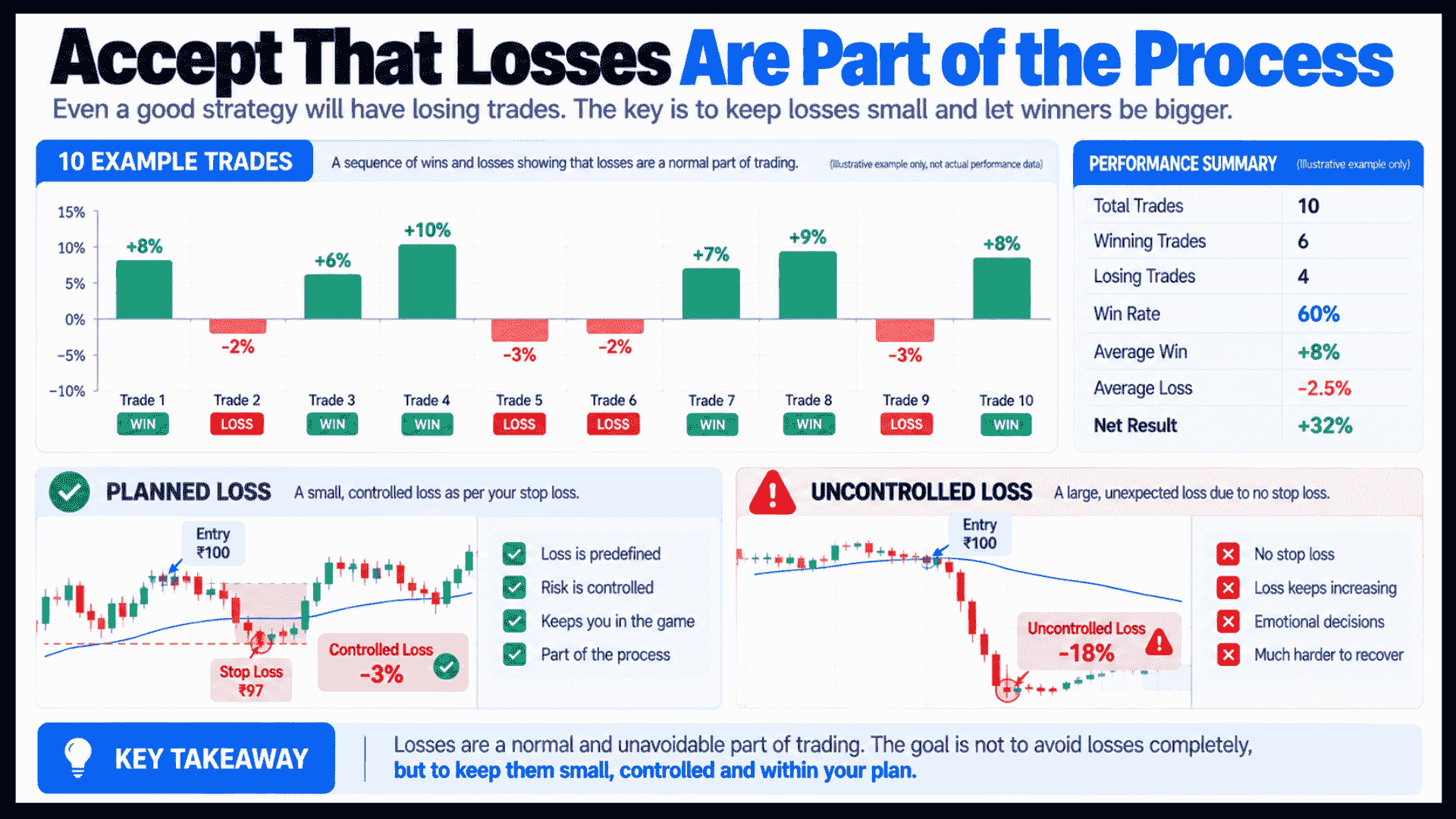
The actual danger sign is a loss that exceeds your planned risk.
That happens because a rule got broken somewhere, not because the market did something unexpected.
Knowing how to manage risk in swing trading is what keeps every loss inside that planned limit.
Rule 9: Review Your Swing Trading Rules, But Not After Every Trade
Your rules are not meant to be rewritten after every single trade. The most recent outcome alone should not drive a change.
A rule that produces a loss once is not necessarily a bad rule.
It may simply be a losing trade within a strategy that wins over a larger sample.
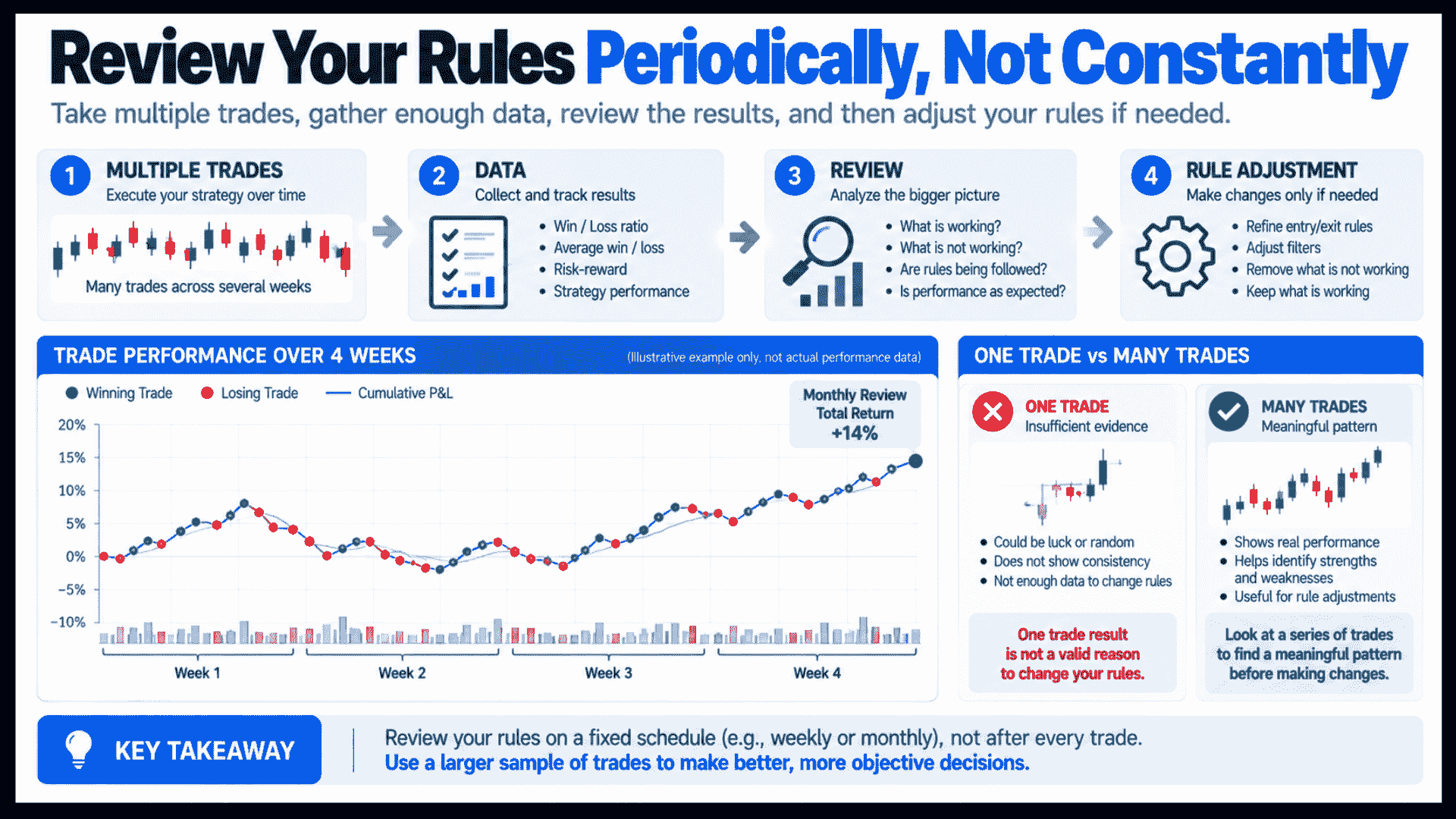
A more sensible approach is reviewing your rule set every one to two months. Use your trading journal from Rule 6 as the evidence base.
Only adjust a rule when the pattern across many trades, not one or two, genuinely supports the change.
Rule 10: Never Trade With Your Rent Money
This sounds like basic financial advice rather than a trading rule.
It belongs here because of how directly it affects trading behaviour.
Trading with money earmarked for rent, bills, or emergencies changes how a trader reacts to a losing streak. The change is usually for the worse.
It adds financial pressure on top of the normal emotional pressure a loss already brings.
Use capital set aside specifically for trading. This is money you have genuinely accepted could be partially lost within your defined risk limits.
It allows the other rules on this list to be followed calmly. Otherwise, they tend to get abandoned under real financial stress.
The Ultimate Second Swing Trading Checklist
Rules only work if they are checked consistently, not just known in theory.
Run a simple pre-trade checklist before every single entry. It keeps these rules from quietly slipping during a busy or emotional trading session:
- Does this setup meet my predefined entry criteria, specifically?
- Have I confirmed the broader market trend supports this direction?
- Is my stop loss decided and placed before I enter?
- Have I calculated position size based on my risk percentage, not conviction?
- Do I already know my exit plan for this specific trade?
If any answer is no, the trade waits, regardless of how good the setup looks in the moment.
Learn to Apply These Rules in Live Market Sessions
Rules on their own are easy to agree with and hard to follow consistently.
That is especially true the first time real money is on the line.
Our Best swing trading classes In India build this discipline into every live session. These rules become habit rather than theory.
Conclusion
Swing trading rules are not exciting, but they turn a good setup into a repeatable process.
Trade only confirmed setups and check the broader market first. Journal every trade and decide exits before entry.
These habits protect you from the most common and costly mistakes.
None of these rules guarantee wins, and losses will still come. What they do is keep those losses small and your decisions calm.
Build them into a pre-trade checklist and follow it every single time. Let consistency, not excitement, drive your results over the long run.
Frequently Asked Questions
Before investing capital, invest your time in learning Stock Market.
Fill in the basic details below and a callback will be arranged for more information: