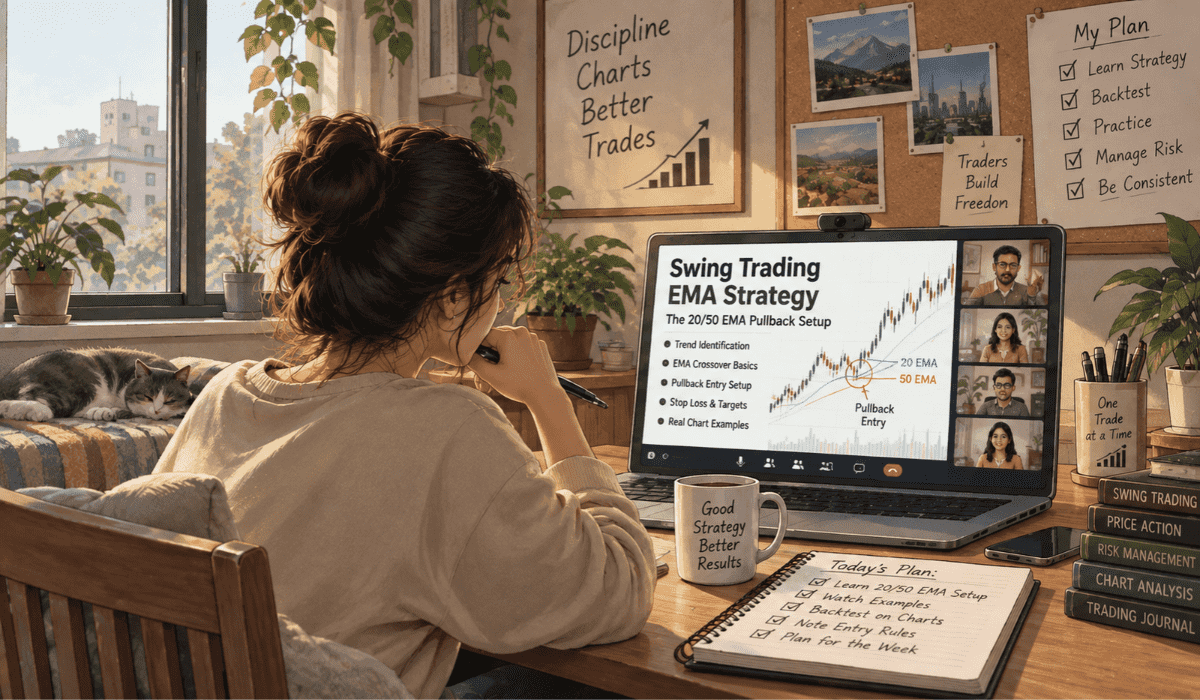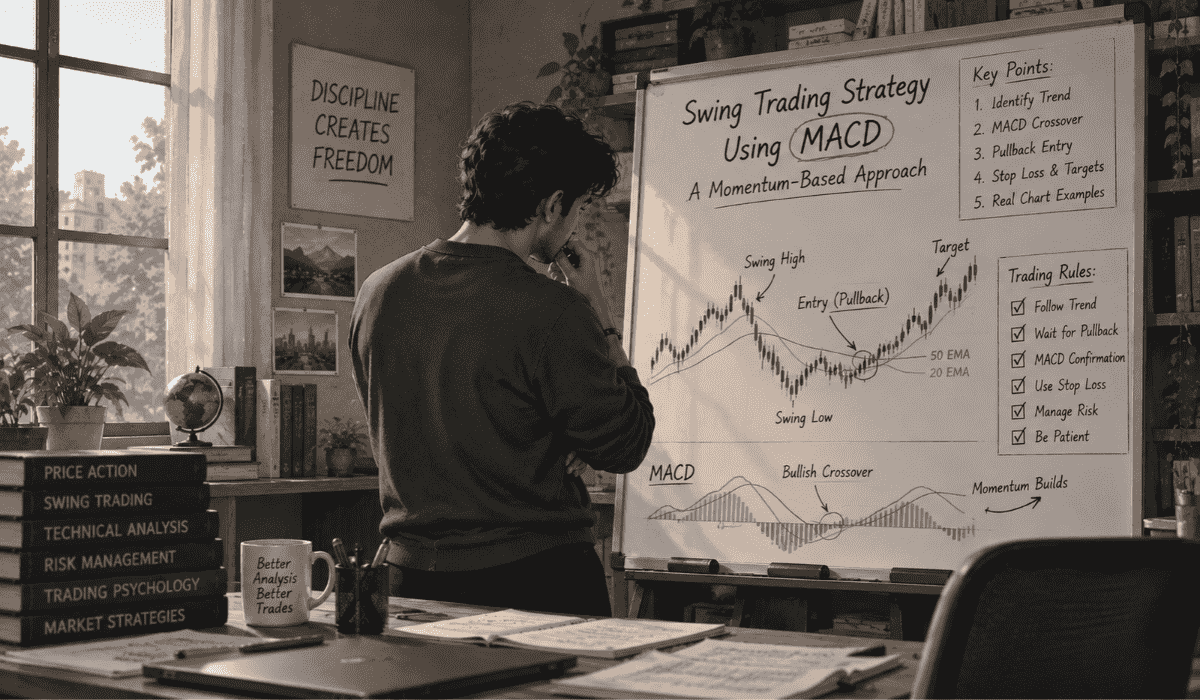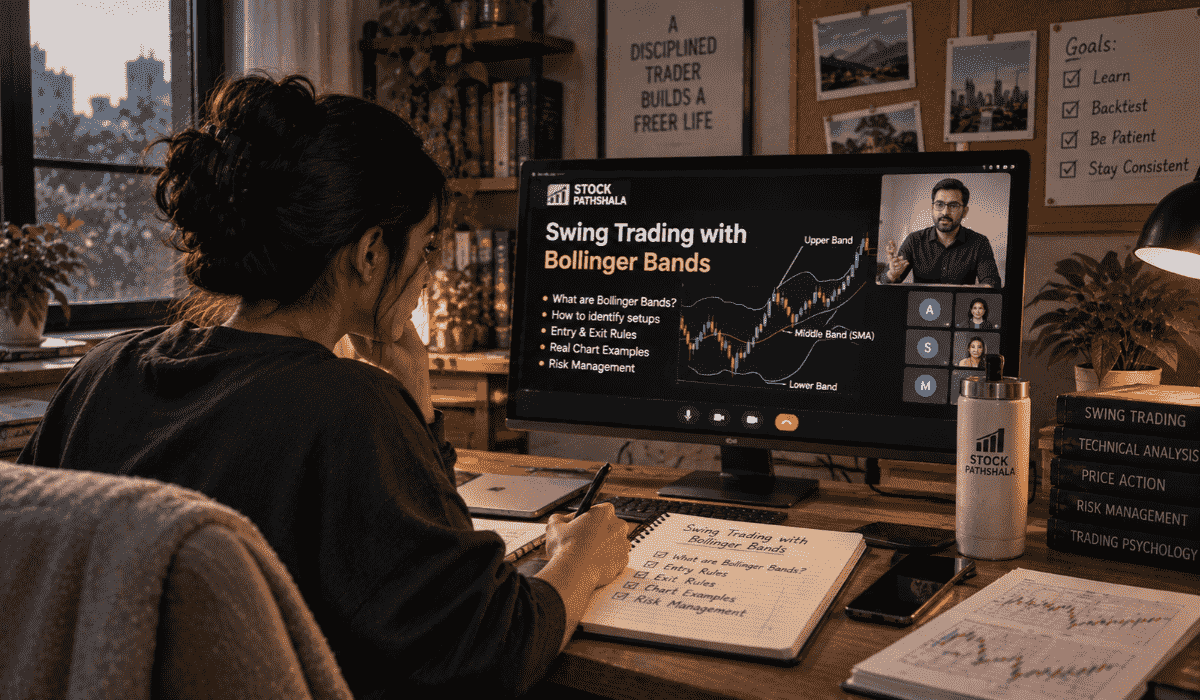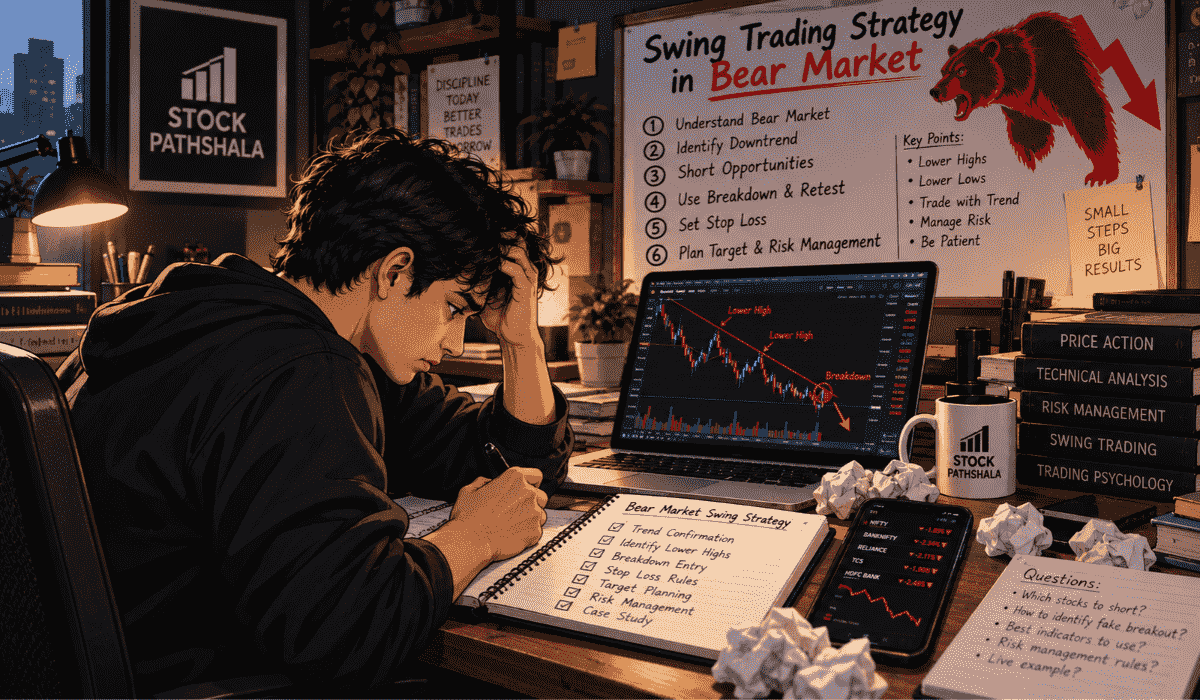



Swing trading with AI is now part of many traders’ research routines. AI assistants have become a regular research tool over the past couple of years.
This is a genuine, growing habit, not just a trend piece. Searches for swing trading using Claude, ChatGPT, and similar tools have climbed alongside it.
If you are still learning about swing trading, this post also shows where AI fits in.
Here is a straight, no-hype look at what these tools genuinely do well. We also cover where they fall short in a real swing trading workflow.
What Does Swing Trading with AI Actually Mean in Practice?
For nearly everyone using it this way, AI does not pick stocks or execute trades.
Instead, it works as a research and learning layer beside your charts, broker platform, and judgment.
It speeds up the parts of research that involve reading, summarising, and explaining. It does not replace live market data or execution.
Swing Trading with AI: Where Do Tools Actually Help?
AI assistants save the most time on tasks built around reading, explaining, and organising information.
Here is where they fit best in a practical swing trading workflow.
Your On-Demand Concept Explainer
Unsure how MACD divergence works? An AI assistant can explain it clearly.
It can also break down a cup and handle swing trading strategy and what the pattern implies.
It answers follow-up questions instantly. That helps you learn faster than a textbook alone.
Long Documents, Cut Down to What Matters
AI can quickly summarise earnings call transcripts, annual reports, and news articles.
It pulls out the parts relevant to your question.
You no longer need to read the entire document.
A Cleaner Swing Trading Journal With AI
AI handles tasks like structuring a trading journal or drafting a checklist for your entry rules.
It can also organise notes on your watchlist of stocks. These tasks rely on language and structure, not live data.
Financial Jargon, Finally Made Simple
Is a term like “risk-reward ratio” or “cup depth” unfamiliar? AI can give you a clear explanation with an example.
This is one of the more genuinely time-saving uses.
A Swing Trading Research Framework Built With AI
You can ask AI to help build a consistent checklist for evaluating a stock.
This suits swing trading with technical analysis: trend, support and resistance, volume, and one momentum indicator.
It is a practical use, provided you apply that checklist to real, current charts yourself.
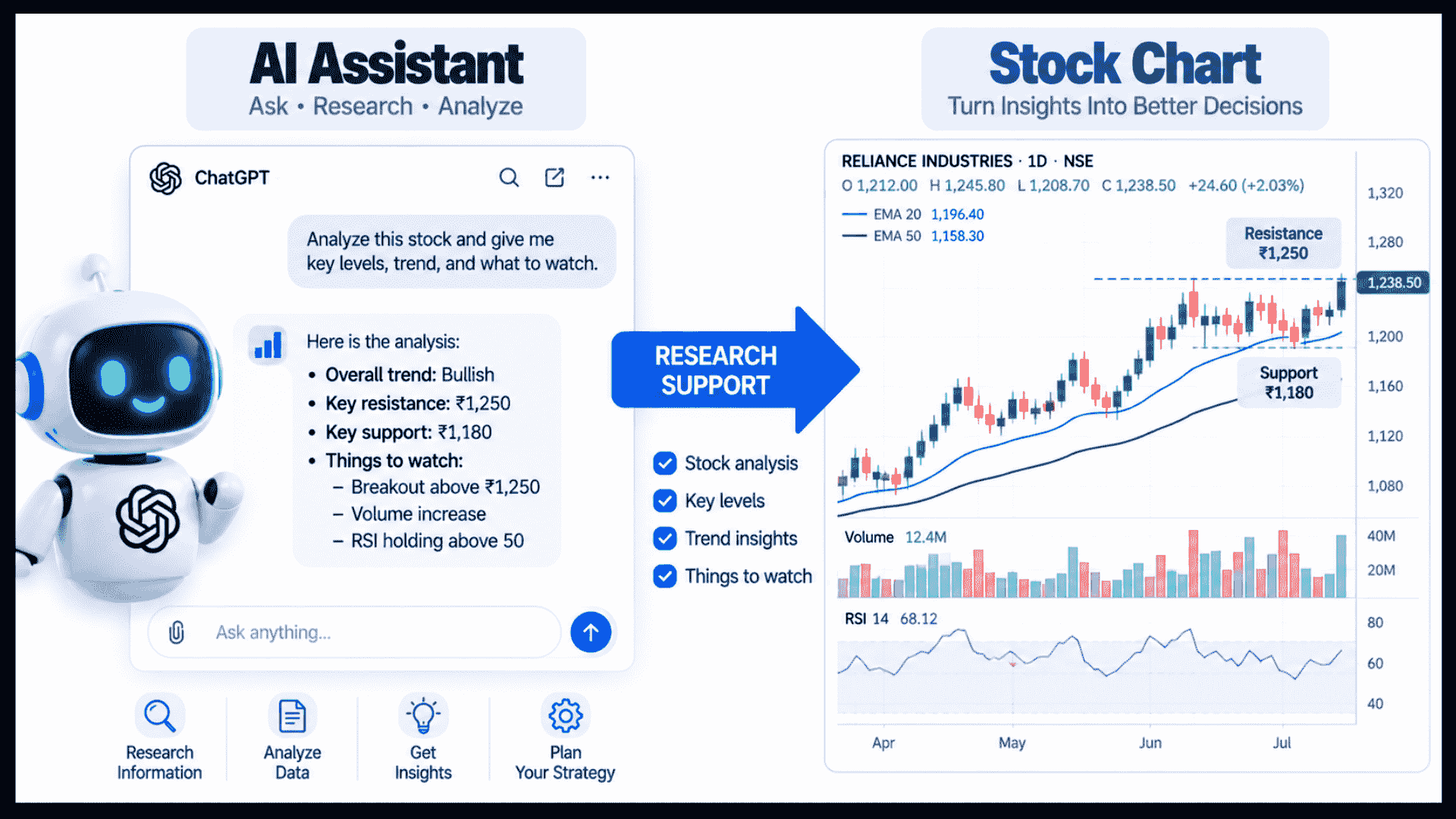
Swing Trading with AI: Understanding the Main Pronlem
AI assistants are useful for research, but they have clear blind spots in a live trading workflow.
Here are five limits every swing trader should know before relying on AI.
Swing Trading with AI: Knowing the Main Problems Before You Start
1. No Real-Time Prices or Chart Data
In a standard conversation, most AI assistants lack real-time stock prices, live volume, or current chart data.
That changes only when a specific tool or connector supplies it.
Treating an AI’s answer as current market data is a genuine mistake. Always verify it against your actual broker or charting platform.
2. AI Cannot Predict Your Next Trade
An AI assistant can explain what a setup typically implies, based on general trading knowledge.
But it cannot reliably predict what a specific stock will do next.
Nobody and nothing can. Treat any tool that implies otherwise with real scepticism.
3. AI Is Not a SEBI-Registered Adviser
In India, personalised investment advice is a regulated activity.
An AI assistant’s output may sound well-reasoned, but it is not a substitute for a SEBI-registered adviser or research analyst.
Do not treat it as a specific buy or sell recommendation.
4. Training Cutoffs Miss Recent News
Every AI model has a training data cutoff. After that point, it does not automatically know what happened.
So always check very recent news, results, or events against a live source. Do not assume the AI’s answer reflects them.
5. Position Sizing Maths Needs Rechecking
Developers build language models for language, not guaranteed arithmetic accuracy.
You may plan to act on position sizing, risk figures, or price levels. These sit at the core of how to manage risk in trading.
So double-check the maths yourself instead of blindly trusting a single generated answer.
Building Your Daily Swing Trading Routine with AI Assistants
Your charting platform should remain your main tool. It gives you the actual chart, live price, and indicator data you need for any trade.
An AI assistant like Claude or ChatGPT works best as a support tool next to it, not a replacement.
For example, if you spot a chart pattern you are unsure about, you can ask the AI to explain how that pattern usually forms and what it signals.
If a company has just released results, you can paste its latest earnings commentary and ask for a quick summary of the key points.
Before entering a trade, you can also ask it to check whether your setup matches your predefined swing trading rules. After the trade, it can help you organise your trading journal.
However, avoid asking questions like “Should I buy this stock right now?” AI does not see live market conditions the way your platform does, so never act purely on its answer.
The final decision should always be yours, based on your own chart reading, risk rules, and current market data.
What Do Big Names in Finance Think?
Even at the top of the industry, experts show real caution here.
Take Greg Jensen, co-chief investment officer at Bridgewater Associates. It is one of the world’s largest hedge funds, and it has invested heavily in AI internally.
Jensen has publicly called relying on chatbots alone for stock picks a “hopeless path.” He cited their inability to reliably anticipate major market turning points.
That limit matters even more when you run a swing trading strategy in bear market conditions. Turning points are hardest to call there.
His caution comes from a firm that uses AI extensively. That makes it worth taking seriously.
It is not a reason to avoid these tools entirely. It is a reason to use them as one input among several, not the final word.
Right Prompt vs Wrong Prompt: A Swing Trading Example?
Here is a genuinely useful prompt:
“Explain how a bearish RSI divergence typically forms and why traders watch for it, with a simple example.”
That is a concept-explanation request. Language models handle this kind of task well.
It draws on established, well-documented trading knowledge.
The same approach works when you are learning swing trading with Bollinger Bands or any other indicator.
Now shift the question to “Does Stock X currently show bearish RSI divergence?” The answer now depends entirely on current price and indicator data.
The AI assistant may not have access to that data in real time.
A well-built AI assistant should then clearly state that it cannot verify current chart data. It should not offer a confident-sounding guess dressed up as an answer.
Why Indian Markets Need Extra Caution With AI?
Indian markets have their own quirks. These include circuit limits, T+1 settlement, expiry day behaviour for derivatives, and short-selling rules.
A general-purpose AI model learns largely from global information. So it may not always get these details exactly right.
This risk grows when SEBI or exchange circulars have recently changed something.
For anything regulatory or mechanics-specific, cross-check against your broker’s documentation or exchange notifications. Treat this as a sensible habit, not an optional extra step.
Swing Trading with AI: Why It’s a Research Layer, Not a Shortcut?
Traders who gain real value from swing trading with AI use it as one layer in a broader process. That process is still largely manual.
It includes their own charting platform for price and indicator data. It also includes their own predefined rules for entries and exits.
The AI assistant sits alongside all of that for explanation, summarisation, and organisation.
Some traders treat AI as a shortcut that replaces chart reading, risk management, and market judgment. They tend to hit the exact limits we discussed above.
It usually happens at the worst possible moment, on a trade that actually mattered.
Learn Swing Trading in Live Expert-Led Classes
AI tools are useful for research and learning. But nothing replaces live, guided practice on real charts under real market conditions.
Our Swing Trading Classes India pair structured setups with live daily sessions. Your decisions stay grounded in current market data and expert guidance, not a static conversation.
Conclusion
Swing trading with AI works best when Claude and ChatGPT act as research partners, not decision-makers.
They explain concepts, summarise earnings commentary, and organise your journal remarkably well.
But they lack live market data and cannot guarantee predictions. They are also not SEBI-registered advisers.
Your charting platform, predefined rules, and risk management must still drive every entry and exit.
Use AI to learn faster and stay organised. Then verify everything against real, current charts. That balance separates a genuinely useful workflow from an expensive shortcut.
Frequently Asked Questions
Before investing capital, invest your time in learning Stock Market.
Fill in the basic details below and a callback will be arranged for more information: