

Every swing trading strategy you read about, whether EMA pullbacks, RSI dips, or a cup and handle breakout, only works with solid risk management behind it.
Your edge plays out across many trades, so you must survive long enough to see it. That survival depends on risk rules, not how clever the setup is.
This post covers the practical risk rules that separate traders who last for years from those who blow up an account in a few bad months.
It applies whether you’re still understanding what swing trading is or already trading actively.
Why Does Swing Trading Risk Management Beat Strategy Selection Every Time?
Here is an uncomfortable truth most trading content skips: a mediocre strategy with excellent risk management will almost always outperform an excellent strategy with poor risk management, over enough trades.
That is because no strategy wins every time.
Even when relying on reliable swing trading patterns to spot potential entries, market volatility can easily invalidate a setup.
Even a genuinely strong swing trading setup might only win 50 to 60 percent of the time.
This is why learning how to manage risk in trading matters so much. Without proper risk control, a handful of losing trades in a row, which will happen eventually to every trader, can erase months of gains or worse.
Rule 1: Risk a Small, Fixed Percentage on Every Trade
The single most important rule in swing trading risk management is simple: risk no more than 1 to 2 percent of your total trading capital on any single trade.
If your account is ₹3,00,000, that is ₹3,000 to ₹6,000 at risk on any one position.
This is calculated from your entry price to your stop loss, not the full value of the position itself.
Adhering strictly to these core swing trading rules ensures that a single bad market movement never threatens your overall financial stability.
Worked Example: How Many Shares Should You Actually Buy?
Suppose you plan to buy a stock at ₹850 with a stop loss at ₹815, a risk of ₹35 per share.
On a ₹3,00,000 account risking 1 percent (₹3,000), your position size works out to roughly 85 shares (₹3,000 divided by ₹35).
Notice this calculation has nothing to do with how much conviction you feel about the trade. It is fixed math, and that is exactly the point.
Rule 2: Set Your Stop Loss Before Entry, Not After the Damage
A stop loss decided after you are already in a losing trade is not a stop loss. It is a hope that keeps moving further away as the loss grows.
Decide your exact stop-loss level while you are still planning the trade, before placing the entry order.
Common approaches when swing trading with technical analysis include placing it just below a recent swing low, below a key moving average, or at a fixed percentage below entry.
Modern traders also use Swing Trading with AI tools to calculate optimal volatility-based stop-loss levels based on historical price ranges.
The method matters less than the discipline of deciding it in advance and actually honouring it.
Rule 3: Let the Swing Trading Risk-Reward Ratio Do the Heavy Lifting
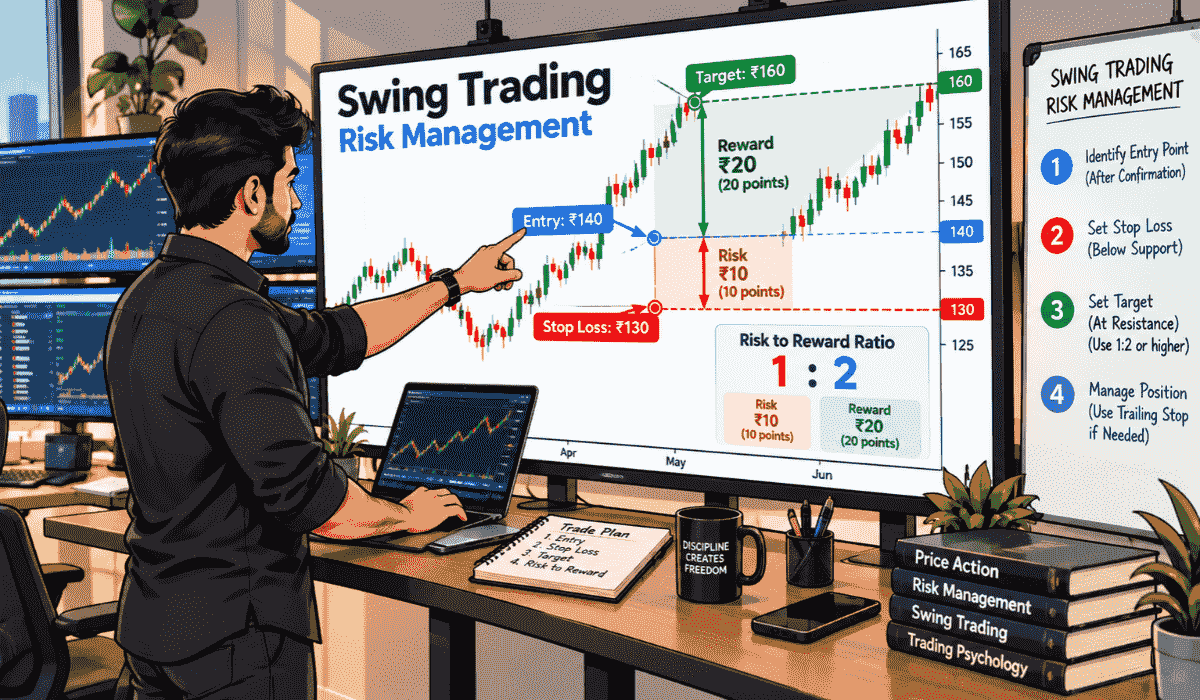
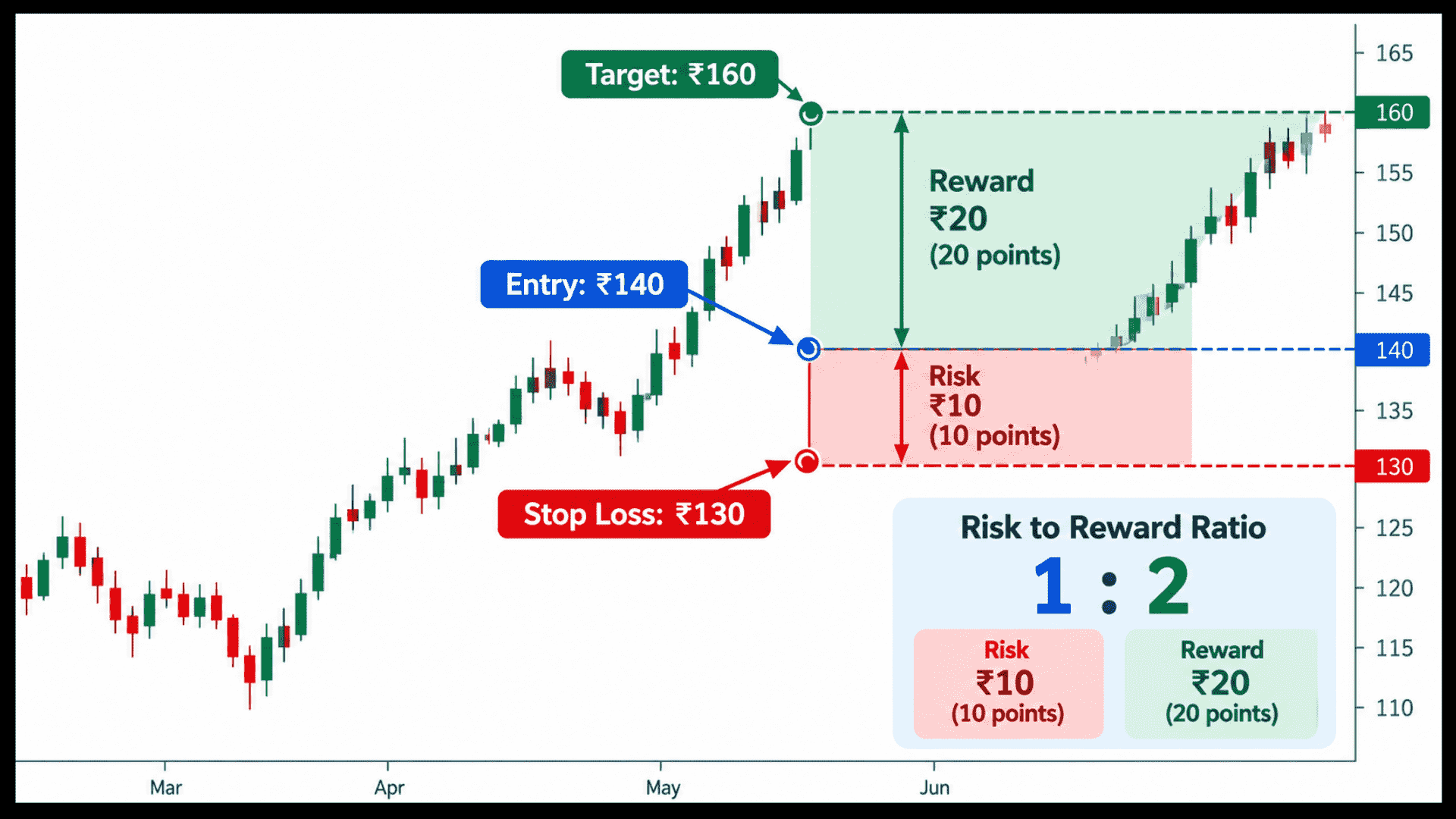
The swing trading risk-reward ratio compares how much you stand to lose against how much you stand to gain on a given trade, expressed as a ratio like 1:2 or 1:3.
If your stop loss is ₹20 below entry and your target is ₹50 above entry, that is a 1:2.5 risk-reward ratio.
This single number matters enormously, because it changes how often you actually need to be right to stay profitable overall.
At a 1:1 ratio, you need to win more than half your trades just to break even after costs.
At a 1:3 ratio, winning just 30 to 35 percent of your trades can still leave you net profitable, since your winners are worth so much more than your losers.
This is exactly why experienced swing traders often skip setups with a weak risk-reward ratio, even when the setup itself looks technically clean, because the maths simply does not favour them enough.
Can You Win Less Than Half Your Trades and Still Profit?
Take twenty swing trades over a few months, each risking ₹2,000 (1 percent of a ₹2,00,000 account) at a 1:2.5 risk-reward ratio.
Even with a modest 45 percent win rate, that is nine winning trades averaging ₹5,000 each (₹45,000) against eleven losing trades of ₹2,000 each (₹22,000).
That is a net gain of ₹23,000. The strategy did not need to win most of the time. The ratio did the heavy lifting.
Rule 4: Why Too Many Open Trades Weakens Swing Trading Risk Management
Running fifteen swing trades simultaneously sounds productive but usually means none of them are being managed properly.
Three to six open positions at a time is a realistic ceiling for most swing traders, allowing genuine attention to each one without spreading focus too thin.
This also has a portfolio-level risk benefit. If every open position is risking 1 to 2 percent, five simultaneous positions cap your total account risk at roughly 5 to 10 percent.
That holds even in an unlikely worst-case scenario where every single trade hits its stop loss the same week.
Rule 5: Averaging Down, the Trap That Turns Small Losses Big
Adding more shares to a position that has already moved against you, hoping to lower your average cost, is one of the fastest ways to turn a small, planned loss into a large, unplanned one.
If the original setup is no longer valid (which is exactly what a hit stop loss level usually signals), adding more capital to it does not fix the thesis.
It just increases the exposure to a trade that already went wrong.
Rule 6: Are Your “Diversified” Positions Really Just One Big Bet?
Holding five different swing positions feels diversified, but if all five are in the banking sector, they are likely to move together, especially during a broad market decline.
That is not five independent risks. It is closer to one concentrated risk spread across five tickers.
Spreading swing positions across a few different sectors, when setups allow it, genuinely reduces the odds of every position getting hit at once by the same sector-specific or market-wide news.
Stress Test: What a Five-Trade Losing Streak Really Costs You?
Numbers convince better than principles alone. Say you have a ₹2,50,000 account, risking 1.5 percent (₹3,750) per trade at an average 1:2.5 risk-reward ratio.
That is a realistic setup for a swing trader using the setups covered elsewhere on this site, such as swing trading with bollinger bands.
Suppose your first five trades of the month all lose, a genuinely bad but entirely plausible stretch even with a sound strategy.
Five losses at ₹3,750 each is ₹18,750, about 7.5 percent of the account. Painful, but survivable, and nowhere close to account-ending.
Now imagine the same five losing trades without proper risk management, risking 5 percent per trade instead of 1.5 percent, chasing bigger position sizes out of frustration after the first couple of losses.
That same losing streak would cost roughly ₹31,250 more, over 12 percent of the account.
The emotional pressure to “win it back” on the sixth trade, often by breaking the very rules that caused the streak, tends to compound the damage further. This is exactly why the fixed percentage rule exists.
Does Swing Trading Risk Management Change as Your Account Grows?
The percentages in this guide (1 to 2 percent per trade) stay consistent regardless of account size, which is precisely the point of using a percentage rather than a fixed rupee amount.
As your capital grows, your position sizes grow proportionally, without ever needing to revisit the underlying risk rule itself.
What often does need revisiting as an account grows is the number of simultaneous open positions.
A trader comfortable managing four positions on a ₹1,00,000 account may find that six or seven positions on a ₹5,00,000 account still fits comfortably within their attention and review capacity.
That is because the rule limiting open positions exists for manageability, not purely for risk math.
Practise These Risk Rules Live on Real Indian Stocks
Beyond individual trade risk, “portfolio heat” refers to the total risk across every open position at once, added together.
If you have four open swing trades, each risking 1.5 percent, your total portfolio heat is 6 percent.
That means a genuinely catastrophic scenario where every position hits its stop the same week would cost 6 percent of the account, not more.
Keeping total portfolio heat under roughly 6 to 10 percent at any given time is a reasonable ceiling for most swing traders.
It gives a hard limit on the worst realistic outcome across all open positions combined, not just per trade.
Ready to Apply These Swing Trading Risk Management Rules with Real Guidance?
Reading risk management rules is straightforward. Applying them consistently under real market pressure, especially on a losing trade, is where most traders struggle.
Our swing trading classes Online build risk management into every setup we teach, live, on real Indian stocks.
Conclusion: Survive First, Profit Second
Swing trading risk management is not the exciting part of trading, but it is the part that keeps you in the game.
Risk a fixed 1 to 2 percent per trade, set your stop loss before entry, and favour setups with a strong risk-reward ratio.
Cap open positions, never average down, watch sector correlation, and keep total portfolio heat in check.
Together, these rules turn a losing streak into a manageable setback rather than an account-ending event. Master them first, and every strategy you learn afterwards gets a real chance to work.
Frequently Asked Questions
Before investing capital, invest your time in learning Stock Market.
Fill in the basic details below and a callback will be arranged for more information: